Container Rain — The Complete Guide 2026: Causes, Dew Point, Desiccant Formula & Solutions
The definitive 2026 guide to container rain: dew point physics, five root causes, psychrometric tables, six prevention solutions, a desiccant quantity calculation formula for 20ft and 40ft containers, silica gel vs clay vs CaCl₂ comparison, and three real CEMACO case studies.
TL;DR — Summary in 3 Minutes
Container rain is condensation from the ceiling and walls of a shipping container dripping onto cargo, causing mold, rust, discoloration, and severe cargo loss. According to the World Shipping Council, 10–15% of all annual marine cargo claims relate directly to moisture condensation. This flagship guide covers: dew point physics, five root causes, a psychrometric RH × temperature table, six prevention solutions, a MIL-D-3464E-adapted desiccant formula with 20ft and 40ft worked examples, a three-product comparison (silica gel vs clay vs CaCl₂), and three real CEMACO Saigon case studies across wood, cashew, and electronics exports.
1. What Is Container Rain? — The Physics of Condensation in Steel Boxes
Container rain is not water leaking from outside. It is condensation from humid air trapped inside the container when the steel ceiling cools below the dew point temperature. Droplets accumulate on the ceiling and fall directly onto cargo. Even a perfectly sealed container will suffer container rain if humidity is not actively managed throughout the voyage.
The phenomenon has been formally studied since the 1970s and is covered in technical guidance from the Institute of International Container Lessors (IICL) and the Cargo Incident Notification System (CINS). Despite widespread industry awareness, container rain remains one of the top five causes of cargo damage claims globally each year.
1.1 Dew Point — The Core Physical Concept
The dew point is the temperature to which air must be cooled — at constant pressure and absolute humidity — for water vapor to begin condensing into liquid. Steel container walls 2–3 mm thick conduct heat almost as fast as bare metal. When the ship crosses from tropical to temperate waters overnight, the container ceiling surface temperature can fall 3–5°C below the interior air temperature within 30–60 minutes, triggering immediate condensation.
Practical examples for Vietnamese export routes:
- Air at 30°C, RH 80% (Ho Chi Minh City summer loading dock) → dew point 26.2°C. The ceiling only needs to cool 4°C before condensation starts.
- Air at 28°C, RH 85% (Hai Phong port July–September) → dew point 25.1°C.
- Air at 25°C, RH 50% (air-conditioned warehouse) → dew point 13.9°C — much safer for temperate-zone voyages.
Quick field formula — no app needed: Td ≈ T − (100 − RH) / 5. Example: 30°C, RH 80% → Td ≈ 26°C (actual 26.2°C, error 0.2°C). Accurate to ±1°C for RH 50–100%. Full psychrometric data from ASHRAE Fundamentals Handbook.
1.2 Vapor Pressure and Total Moisture Load
A 40ft standard dry van holds approximately 67.7 m³ of air. At 30°C/RH 80%, total water in air ≈ 1.56 kg. If the ceiling cools to 20°C, up to 0.75 kg may condense overnight. But one cubic meter of wood cargo at MC 15% contains approximately 75 kg of water — orders of magnitude more than initial air moisture. Desiccant must continuously absorb moisture released from cargo throughout the entire voyage, not just at packing time. Per IICL technical guidelines, standard steel containers have no thermal insulation between ceiling and walls — the primary structural reason for container rain.
2. Five Root Causes of Container Rain
Container rain rarely results from a single factor. Most incidents involve two or more of the following causes occurring simultaneously, each compounding the others.
2.1 Climate Zone Transitions Along the Voyage Route
A container packed in Ho Chi Minh City (tropical: 28–35°C, RH 70–90%) destined for Hamburg (temperate: 5–15°C) or Los Angeles crosses climate zones with 20–30°C temperature differentials. According to CINS, North Atlantic and North Pacific routes during October–March record container rain damage rates 2–3× higher than purely tropical routes. Even within a single day at sea, the diurnal cycle — ceiling at 60°C midday, 20°C at 2 AM — creates a continuous moisture pump redistributing moisture from cargo surfaces to the container ceiling and back again. Over a 35-day voyage, this mechanism can transfer 5–10× the initial air moisture load from high-MC wood cargo.
2.2 High Moisture Content in Cargo
Vietnamese wood exports are the most common source of excessive container moisture. Finger-joint boards and furniture packed at MC 14–18% continue releasing moisture for the full 25–45 day voyage to reach equilibrium with drier destination conditions (EMC 6–10% in North America/Europe). Agricultural goods — cashews, coffee, rice in woven bags — exchange moisture based on the difference between cargo water activity (aW) and container atmosphere RH. These localized high-RH zones are the primary mechanism behind aflatoxin and mold contamination events. See: Preserving agricultural goods in containers and FDA-compliant food desiccants.
2.3 Air Infiltration Through Container Imperfections
Standard ISO dry vans are not airtight. Aged door gaskets, corner fitting micro-gaps, and vent openings allow warm moist outside air to enter when transiting high-humidity environments — Colombo, Port Klang, Tanjung Pelepas, Panama Canal. Per IICL technical bulletins, containers over five years old show 40–60% greater air infiltration than new units, adding an unplanned moisture load above the packing-time calculation.
2.4 Diurnal Thermal Cycling — The 24-Hour Moisture Pump
On-deck containers receive direct solar radiation during daylight hours, driving ceiling temperatures to 55–70°C. After sunset, rapid radiative cooling drops ceiling temperatures to 15–25°C within 2–3 hours. The cycle drives evaporation from cargo during the day and condensation onto the ceiling at night. Over a 35-day voyage, total moisture transferred from wood cargo at MC 14% can reach 15–20 kg per cubic meter of cargo — even if the initial air load at packing was only 1.5 kg. Under-deck containers experience smaller swings but are not immune, as hull temperature varies continuously with sea temperature and port proximity.
2.5 Intrinsic and Hidden Moisture Sources
Freshly washed industrial machinery with residual moisture in recesses; MAP-packaged food with high internal RH; fresh produce still transpiring during transit; green wood pallets not meeting ISPM-15 heat treatment requirements; wet-cast construction materials packed too soon after production. A single untreated wood pallet can contribute 5–8 kg of free moisture. These sources are particularly dangerous because they are invisible without instruments at packing time. See: Desiccants for wood export cargo.
3. Psychrometric Science — Dew Point Table and Moisture Quantities
Psychrometric analysis is the engineering foundation for designing container humidity control. The table below provides quick-reference dew point values from ASHRAE Fundamentals, covering the temperature and humidity ranges most relevant to Vietnamese export logistics.
| Temperature (°C) | RH 50% | RH 60% | RH 70% | RH 80% | RH 90% | RH 100% |
|---|---|---|---|---|---|---|
| 15°C | 4.6 | 7.3 | 9.5 | 11.6 | 13.4 | 15.0 |
| 20°C | 9.3 | 12.0 | 14.4 | 16.4 | 18.3 | 20.0 |
| 25°C | 13.9 | 16.7 | 19.1 | 21.3 | 23.2 | 25.0 |
| 28°C | 16.5 | 19.5 | 21.9 | 24.2 | 26.1 | 28.0 |
| 30°C | 18.4 | 21.4 | 23.9 | 26.2 | 28.2 | 30.0 |
| 35°C | 23.0 | 26.1 | 28.7 | 31.0 | 33.0 | 35.0 |
| 40°C | 27.6 | 30.8 | 33.5 | 35.9 | 37.9 | 40.0 |
Reading guide: Container packed at Ho Chi Minh City in July (30°C, RH 80%) has dew point 26.2°C. Any ceiling surface below 26°C triggers condensation immediately. During a winter North Pacific crossing, ceiling temperatures routinely fall below 15°C — making container rain essentially certain without adequate desiccant. Key absolute humidity values: Ho Chi Minh City summer (30°C, RH 85%) → 23.0 g/m³, total in 40ft: 1.56 kg; Singapore (33°C, RH 80%) → 24.8 g/m³, total 40ft: 1.68 kg; Hamburg winter (5°C, RH 80%) → 5.5 g/m³, total 40ft: 0.37 kg. See: Silica Gel vs Clay vs CaCl₂ for container applications.
4. Six Solutions to Prevent Container Rain
No single solution is sufficient for all cargo types and routes. Best practice is a layered defense combining two or more approaches. Solutions are listed in order of increasing cost and comprehensiveness.
4.1 Large Desiccant Packets (500g–1,000g) Placed Within Cargo
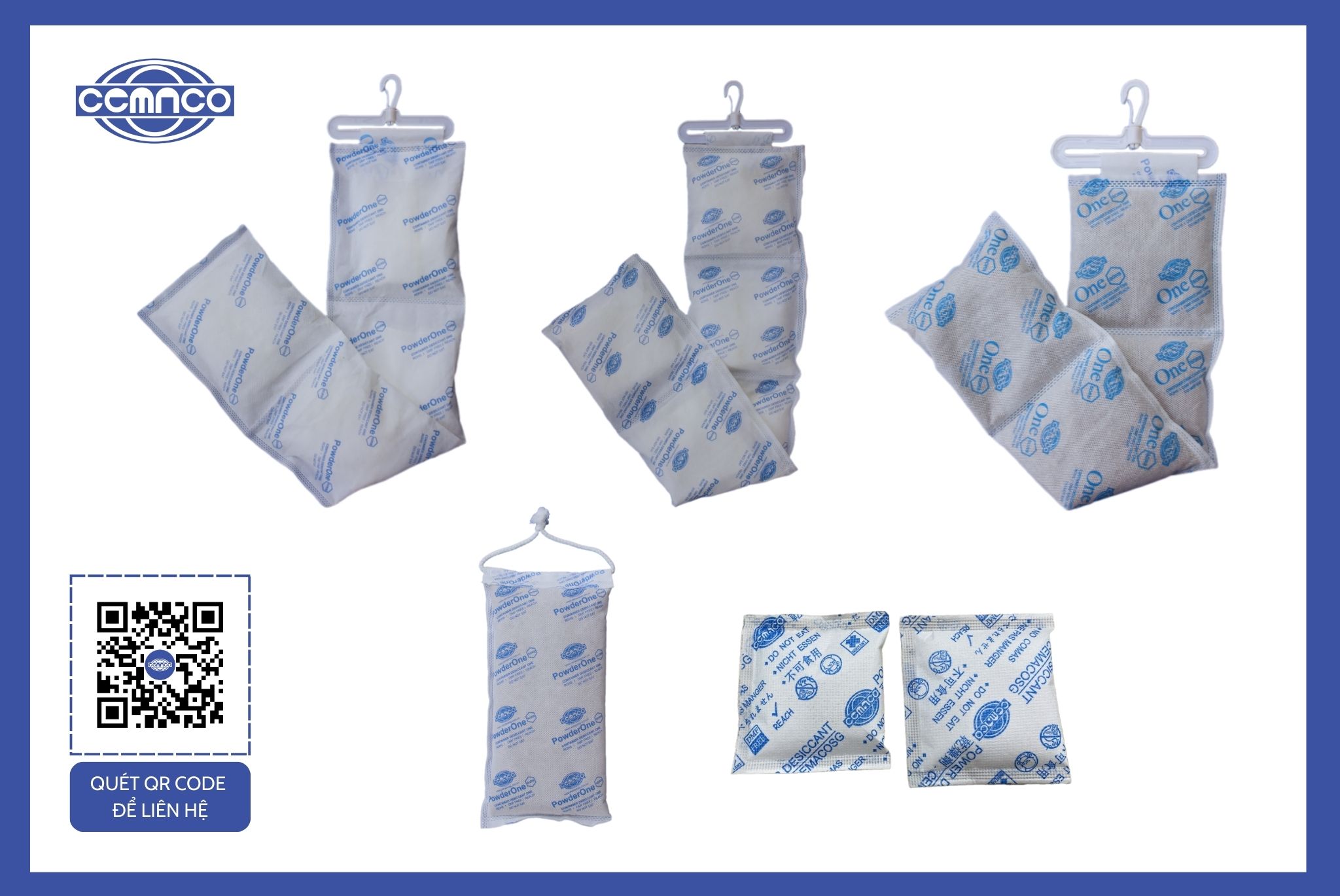
The most basic and widely deployed solution. Silica gel or clay packets placed between pallet rows, inside carton boxes, or in void spaces throughout the cargo. Zero process change required; low cost per unit. Limitation: absorption effectiveness is limited by proximity to humid zones. CEMACO products: Silica Gel 500g non-woven hanging strip (electronics, apparel, pharmaceuticals); Clay 500g non-woven hook mount (wood, agricultural, industrial); CaCl₂ 1,000g hanging strip (highest absorption, voyages over 45 days).
4.2 Container Desiccant Hanging Strips — Full-Length Ceiling-Zone Deployment
Strip-format bags 80–120 cm long containing 500g–2,000g of desiccant, suspended from container crossbar hooks. This places desiccant directly in the highest-convection zone beneath the ceiling — where RH is 5–15 percentage points higher than at cargo level due to thermal stratification — where condensation initiates first. Superior moisture distribution along the full container length. A two-person team loads a 40ft container in under 10 minutes. Standard positions: 4 points for 20ft, 8–10 points for 40ft. Installation guide: Container hanging desiccant installation guide. Products: Silica Gel 1,000g 4-pack hanging strip and Clay 1,000g 4-pack hanging strip.
4.3 Cargo Wrapping with PE Foam or Shrink Film
Wrapping pallets or individual units with polyethylene foam or shrink PE film creates a physical vapor barrier at the cargo surface. This does not reduce total container moisture but prevents ceiling drips from directly contacting cargo. Particularly effective for metals susceptible to rust, electronics, and premium wood products. Cost premium: 2–5% over standard packing. Direct drip damage reduction: 80–90%. CEMACO supplies PE foam film and shrink PE film — see packaging materials product range.
4.4 Container Vents — Limited Effectiveness in Commercial Practice
Vents benefit only when outside dew point is lower than inside the container. In tropical port environments, the outside dew point of 26–30°C often equals or exceeds the inside value — making open vents counterproductive. Effective vent management requires continuous dew point monitoring not practically available on commercial voyages. Do not count vents toward reducing your desiccant quantity calculation.
4.5 Container Liner — Physical Separation from Steel Surfaces
A polyethylene film liner installed inside the full container interior separates cargo from steel walls and ceiling. Most effective for bulk cargo (rice, coffee, soybeans). Cost: VND 2–4 million per 40ft container. Critical: liner must always be combined with desiccant inside the liner — without desiccant, the liner traps cargo-emitted moisture, potentially reaching RH 90–100% and accelerating mold growth. See: Standard moisture-proof container loading procedure.
4.6 Pre-Shipment Moisture Control — Address the Root Cause
The most cost-effective long-term solution: reduce cargo MC to target level before sealing the container. Wood for US/Canada: MC ≤12%, verified by calibrated resistance moisture meter at minimum five points per unit. Wood for Japan: MC ≤10%. Cashews and coffee: aW ≤0.70. Industrial machinery: fully dry after cleaning. Additional drying cost: VND 100,000–500,000 per tonne. A single prevented claim recovers months of drying costs. See: Desiccants for wood export cargo and FDA food desiccants.
5. Desiccant Quantity Calculation — Worked Examples for 20ft and 40ft
Correctly sizing the desiccant load is the most critical technical step in container humidity management. Undersizing causes container rain. Oversizing wastes budget without proportional additional benefit.
5.1 Input Parameters
- V_air: free air volume (m³) = container internal volume − cargo volume
- AH_load: absolute humidity at loading (g/m³) — from dew point table
- AH_target: target absolute humidity (g/m³) — typically RH 40% at coldest voyage temperature
- W_cargo: cargo weight (kg, dry basis for hygroscopic goods)
- EMC_delta: difference in equilibrium moisture content (%) between origin and destination conditions
- Safety_factor: 1.5 for voyages ≤30 days; 2.0 for 31–60 days; 2.5 for >60 days
5.2 MIL-D-3464E Adapted Calculation Formula
W_des (g) = (V_air × (AH_load − AH_target) + W_cargo × EMC_delta / 100) × Safety_factor
Number of packets = W_des / packet_weight_g  (round up)
Reference standard: ASTM E96 Standard Test Methods for Water Vapor Transmission of Materials. The safety factor accounts for air infiltration losses, thermal cycling efficiency reduction, and inter-packet performance variation across production batches.
| Parameter | 20ft Container (Wood) | 40ft Container (Wood) |
|---|---|---|
| Container internal volume (m³) | 33.2 | 67.7 |
| Cargo volume (m³) | 22.0 | 45.0 |
| Free air V_air (m³) | 11.2 | 22.7 |
| Loading conditions (T, RH) | 30°C, RH 80% | 30°C, RH 80% |
| AH_load (g/m³) | 24.4 | 24.4 |
| AH_target — RH 40%, 10°C (g/m³) | 3.8 | 3.8 |
| Cargo weight (kg) | 8,000 | 16,000 |
| EMC_delta wood VN → US (%) | 3 | 3 |
| Safety factor (35-day voyage) | 2.0 | 2.0 |
| W_des required (g) | ≈ 968,000 g | ≈ 1,923,000 g |
| 500g packets needed | 1,936 | 3,846 |
| 1,000g packets needed | 968 | 1,923 |
This shows the extreme case for high-MC wood cargo. Electronics with EMC_delta near zero require only 8–12 hanging strips per 40ft. Always measure actual cargo MC and use the formula. CEMACO provides free quantity consultation — request a quote or call 0983 929 232. See also: Container desiccant calculator — Excel download and How many packets per container — detailed FAQ.
6. Comparing Three Container Desiccants: Silica Gel, Clay, and CaCl₂
| Criterion | Silica Gel (SiO₂) | Clay Desiccant | Calcium Chloride (CaCl₂) |
|---|---|---|---|
| Absorption at RH 80% | 25–30% of weight | 15–20% of weight | 200–300% of weight |
| State after saturation | Remains solid — safe | Remains solid — safe | Liquefies — leakage risk if containment fails |
| Working temperature range | −40°C to +80°C | 0°C to +50°C | 0°C to +40°C |
| Corrosion risk | None — chemically inert | None — chemically inert | Yes — saturated brine corrodes iron, steel, aluminum |
| FDA food-grade | Yes — 21 CFR 184.1711 | Yes — GRAS | Not recommended for food |
| RoHS / electronics | Yes — white Type A, no heavy metals | Yes — standard grades | Not standard for electronics |
| Regenerable | Yes — 4 to 8 cycles at 110–130°C | Yes — 2 to 4 cycles at 120–150°C | No — single use only |
| Relative cost per gram absorbed | Medium (baseline) | 30–40% lower than silica gel | Low per unit weight; no reuse |
| Best voyage length | All lengths with correct sizing | Up to 45 days below 50°C | 45+ days for non-metal, non-food cargo |
| CEMACO recommendation | Electronics, apparel, pharma, food | Wood, agricultural, industrial | Agricultural in woven bags, long voyages, non-food |
For IMO IMDG dangerous goods shipments requiring certified desiccant non-reactivity, silica gel white Type A is the easiest to document and most widely accepted by customs and maritime authorities worldwide. Reference: IMO IMDG Code. For deeper analysis: Silica Gel vs Clay vs CaCl₂ — Full Comparison (Flagship F4) and How to choose the right container desiccant.
7. Three Real Case Studies — CEMACO Saigon Solving Container Rain
Company names are anonymized; technical details are retained in full. These cases illustrate how CEMACO diagnoses and resolves container rain across three export industries.
7.1 Finger-Joint Board to North America: From 18% Claim Rate to Zero
Background: Company A (Binh Duong Province) exported finger-joint boards to US and Canadian distributors. October 2023 to March 2024: 18% of containers received mold and warping complaints. Average loss per container: VND 45 million. Cumulative six-month losses exceeded VND 800 million.
CEMACO Diagnosis: Wood MC at packing: 14–16% (target ≤12% for US/Canada). Current desiccant: 4 × 200g clay packets per 40ft container — insufficient by 20–30× based on MIL-D-3464E calculation. Voyage: 28–35 days, North Pacific in winter — peak thermal cycling severity.
CEMACO Solution: (1) Kiln-drying advisory to reach MC ≤12%, verified at five measurement points per board. (2) Upgraded to 8 × Clay 1,000g 4-pack hanging strips + 4 × Clay 500g hook packets per 40ft. (3) PE foam wrapping on all pallets as secondary drip protection.
Result: Zero container rain complaints in 127 containers shipped April 2024 to May 2026. Additional desiccant cost: VND 1.2 million per container. Net saving versus a single claim: VND 43.8 million. ROI on the desiccant upgrade: 36× per protected container.
7.2 W320 Cashews to EU: Preventing Aflatoxin Contamination from Moisture
Background: Company B (Binh Phuoc Province) exported W320 cashew kernels to Germany and the Netherlands. July 2024: one 20ft container refused at Hamburg with aflatoxin B1 at 3.2 μg/kg — exceeding EU maximum 2 μg/kg (EC Regulation 1881/2006). Total loss: approximately VND 1.8 billion including cargo value, return shipping, and disposal.
CEMACO Diagnosis: Loading at 32°C, RH 90% (dew point 30.5°C). Desiccant in use: 6 × 100g silica gel at floor level — total capacity ≈1.8 kg against a requirement of 8–12 kg. Woven polypropylene outer bags with no inner moisture barrier allowed direct vapor exchange. Localized high-RH zones enabled Aspergillus flavus growth. Reference: HACCP certification for desiccants and EC 1935/2004 food contact desiccants.
CEMACO Solution: (1) Switched to HACCP + FDA GRAS food-grade silica gel 500g hanging strips, full CoA per batch. (2) Recalculated load: 12 × 500g strips per container + one 50g inner-bag desiccant per 25 kg cashew sack. (3) Pre-shipment aW testing: all batches verified aW ≤0.60. (4) PE inner bag inside woven outer bags for highest-risk batches. Reference: CEMACO Silica Gel MSDS 2025.
Result: Zero EU border rejections over 8 months and 43 containers. Buyer confidence restored. Order volume increased 35%.
7.3 PCB and SMD Export to Japan: JEDEC J-STD-033 Compliance with Data Logger Proof
Background: Company C (Ho Chi Minh City) exported assembled PCBs and SMD components to an Osaka manufacturer. Requirement: JEDEC J-STD-033D compliance (RH ≤40%, MSL 2–4) with data logger records per delivery. First shipment April 2024: logger recorded peak RH 68% during transit of Luzon Strait in a tropical depression. Quality hold by customer; 11-day production delay; penalty claim JPY 2.4 million.
CEMACO Solution: Layered protocol: (1) Inner packaging — each component reel sealed in anti-static dry bag with 50g Tyvek silica gel, vacuum sealed. (2) Container level — 10 × 500g orange-indicator silica gel strips (cobalt-free, RoHS compliant) per 40ft; orange turns blue-green at saturation for visual post-arrival inspection. (3) Calibrated temperature-RH data logger (±2% RH) at cargo geometric center. (4) Full CoA, MSDS, and RoHS declaration per shipment. See: Silica gel for electronics — ESD and JEDEC J-STD-033.
Result: 12 consecutive shipments May 2024 to May 2026: all data logger records show maximum RH ≤33%. Japanese customer approved CEMACO as preferred desiccant supplier. Annual container volume grew from 50 to 180 per year. Solution cost: VND 350,000 per container versus JPY 2.4 million for a single failed shipment — ROI approximately 200× per incident prevented.
8. FAQ — Container Rain and Desiccant Technical Deep Dives
These questions extend significantly beyond What is Container Rain?, focusing on dew point calculations, liner interactions, vent management, and specific industry scenarios.
8.1 How Do I Calculate Dew Point Quickly in the Field?
Use the simplified Magnus rule: Td ≈ T − (100 − RH) / 5. Example: 30°C, RH 80% → Td ≈ 26°C (actual 26.2°C — error 0.2°C). Reliable for RH 50–100%, temperatures 10–45°C. For full precision, use the Magnus–Tetens formula or Table 1 above.
8.2 Can a Container Liner Fully Replace Desiccant?
No. A liner prevents ceiling drips from hitting cargo but does not remove moisture from the enclosed air inside the liner. Cargo continues releasing moisture into the sealed liner space, potentially reaching RH 90–100% inside — worse than without a liner. Always use liner combined with desiccant: desiccant absorbs cargo-emitted moisture before it can condense.
8.3 Does Opening Container Vents Help Prevent Container Rain?
Only when outside dew point is lower than inside the container. In tropical ports — Colombo, Port Klang, Tanjung Pelepas — outside dew point of 26–30°C often equals or exceeds the inside value, making open vents counterproductive. Effective vent management requires continuous monitoring not practically available on commercial voyages. Do not count vents toward reducing your desiccant load calculation.
8.4 Why Does Dry Vietnamese Wood Still Cause Container Rain in the US?
Vietnamese tropical EMC equilibrium (12–16%) differs from US temperate destination EMC (6–10%). Wood releases 4–10% of its dry weight in moisture during transit to reach equilibrium. For a 40ft container of 16,000 kg wood at MC 15% going to MC 8%, approximately 1,120 kg of moisture is released — desiccant alone cannot economically absorb this volume. Pre-shipment drying to MC ≤12% is essential; desiccant manages the residual emission.
8.5 What Is the Difference Between a Hanging Strip and a Standard Packet?
Hanging strip packets use heavier non-woven fabric rated for vertical suspension from container crossbar hooks, placing desiccant in the ceiling-adjacent airspace where RH is 5–15 percentage points higher than at cargo level due to thermal stratification. This achieves faster absorption where condensation risk is highest. Standard in-cargo packets complement hanging strips by absorbing moisture near individual cargo units. Best practice: use both in combination.
8.6 How Can I Tell If Desiccant Is Saturated After a Voyage?
Silica gel white (no indicator): weight gain of more than 20% versus original label weight. Silica gel orange indicator (non-cobalt): color change from orange to blue-green at approximately 15–20% moisture uptake. Clay: feels softer and heavier, may have a musty odor. CaCl₂: granules liquify completely. Document condition at unloading to calibrate quantities for subsequent identical shipments.
8.7 Do Reefer Containers Get Container Rain?
Reefer containers have 60–100 mm polyurethane insulation — thermal conductance 40–50× lower than bare steel — significantly reducing condensation risk versus dry vans. However, reefers operating without active refrigeration (power-off, waiting at tropical ports, failed compressor) can still develop condensation, especially with hygroscopic cargo. Desiccant is recommended for any non-powered reefer operation.
8.8 Does Desiccant Affect Oxygen Levels in the Container?
No. Silica gel and clay desiccants adsorb water molecules only via physical forces (Van der Waals and capillary condensation). They do not react with or adsorb oxygen, nitrogen, or CO₂. Container oxygen remains at normal atmospheric 21% throughout the voyage. This is the key distinction from oxygen scavengers (iron-based, designed for MAP food packaging) which actively remove oxygen.
8.9 How Many Hanging Positions Does a 40ft High Cube Need?
A 40ft High Cube has approximately 4 m³ more air volume than a standard 40ft due to the extra 300 mm ceiling height. CEMACO recommendation: 10 hanging positions — 5 per side at 2.4 m intervals. Each position receives one 500g dual-bag strip or one 1,000g 4-pack strip. For detailed hook position diagrams: Container desiccant hanging guide.
8.10 For Voyages Longer Than 60 Days, Silica Gel or CaCl₂?
For voyages over 60 days with non-metallic, non-food cargo where FDA is not required: CaCl₂ (150–300% absorption) offers superior cost-per-gram performance. A 1,000g CaCl₂ packet absorbs 1.5–3.0 kg versus 0.25–0.30 kg for silica gel. Tradeoffs: CaCl₂ liquefies when saturated (leakage risk), cannot be regenerated, and is not suitable for metals or food. For metals, electronics, or food on long voyages: use silica gel with safety factor 2.5. See: Silica Gel vs Calcium Chloride — detailed comparison.
8.11 Can Container Rain Occur While the Container Is Stored at Port?
Yes — a frequently overlooked scenario. Containers waiting 5–14 days on a tropical port stack undergo the same diurnal temperature cycling as at sea: ceiling at 55–65°C midday, 25–28°C at night with RH 80–90%. Container rain can begin before the vessel departs. Load desiccant at the time of cargo packing, not at the time of vessel departure or container gate-in.
9. Container Rain Prevention Checklist — Before You Seal the Container
Use the following checklist for every container departure to verify all humidity management measures are in place. Share this with your warehouse and logistics teams to standardize the pre-shipment protocol.
9.1 Pre-Loading Verification
- Measure and record cargo MC or aW for all hygroscopic goods (wood, agricultural, paper). Use calibrated instruments.
- For wood cargo: verify MC ≤12% (US/Canada/EU) or ≤10% (Japan) at minimum five measurement points per unit.
- For agricultural goods: verify aW ≤0.70 before packing. Do not pack cargo showing visible moisture or condensation.
- For machinery: confirm all surfaces are dry. Run compressed air through blind bores and recesses if recently washed.
- Check that wood pallets carry ISPM-15 heat treatment marking (HT or MB stamp) — untreated green pallets are a significant hidden moisture source.
9.2 Container Inspection Before Loading
- Inspect door gaskets for cracks, deformation, or gaps. Replace worn gaskets — a broken gasket admits warm tropical air on every port transit.
- Check container floor for moisture, mold, or residual cargo from previous use.
- For aged containers (over five years), allow extra desiccant margin of 15–20% above calculated quantity to account for higher infiltration rates.
- Verify container roof and side panels are intact — no visible dents that breach the protective coating exposing bare steel to accelerated temperature cycling.
9.3 Desiccant Loading Protocol
- Calculate desiccant quantity using the MIL-D-3464E adapted formula in Section 5, not a rule of thumb.
- Load desiccant immediately after packing — do not leave the sealed container without desiccant overnight.
- For hanging strips: install at all specified crossbar hook positions before the final cargo row is loaded (not after sealing).
- For in-cargo packets: distribute evenly throughout the cargo mass, not concentrated at one end.
- Check that desiccant packets are sealed and undamaged before loading — compromised packets provide no absorption.
- Record lot number and quantity loaded on the packing list and container seal log for traceability.
9.4 Documentation Requirements by Destination Market
Different export destinations have varying requirements for desiccant documentation accompanying the cargo:
- United States (FDA-regulated food products): Certificate of Analysis (CoA) confirming FDA 21 CFR 184.1711 or GRAS status. MSDS. Confirm desiccant type is free of cobalt chloride.
- European Union (food, cosmetics, pharmaceuticals): Declaration of compliance with EC Regulation 1935/2004 (food contact materials). HACCP certification for supplier. REACH compliance confirmation (no SVHC substances). See: EC 1935/2004 food contact desiccants.
- Japan (electronics, precision goods): RoHS declaration (6 restricted substances). CoA with heavy metal absence confirmation. JEDEC J-STD-033 compliance statement for MSD shipments. Data logger records if required by buyer.
- General export (all markets): MSDS in English (and destination country language for some markets). Certificate of Analysis. Packing list notation of desiccant type, quantity, and lot number. See: MSDS for silica gel desiccant.
CEMACO provides full documentation packages for all destination markets: CoA, MSDS, HACCP certificate, RoHS declaration, and EC 1935/2004 compliance letter. Download documentation: MSDS Silica Gel 2025 | Technical Data Sheet Silica Gel 2025.
9.5 Post-Arrival Inspection Protocol
- Inspect all desiccant packets before disposal — record whether saturated, partially saturated, or unused.
- For hanging strips with indicator (orange silica gel): photograph the color of all strips before removal as a voyage condition record.
- If saturation is 100% (all strips exhausted), increase desiccant quantity by 30–50% for subsequent identical shipments.
- If saturation is below 30%, consider whether desiccant quantity is oversized or voyage conditions were unusually mild.
- Document any cargo damage attributable to moisture, including location (top vs. bottom vs. side of container), type of damage, and estimated loss value. This data improves future desiccant specifications.
CEMACO maintains voyage records for all repeat customers and uses post-arrival inspection data to refine desiccant recommendations over time. This continuous improvement cycle is part of the value added by working with an experienced, ISO-certified supplier.
Request a Container Desiccant Quote — CEMACO Saigon
CEMACO Saigon supplies a complete range of container desiccants: silica gel hanging strips 500g–1,000g, clay hanging strips 500g–1,000g, and CaCl₂ powder 1,000g — all ISO 9001 and HACCP certified. Free technical consultation on desiccant type selection and quantity calculation for your specific cargo and voyage route. Same-day delivery within Ho Chi Minh City; next-day nationwide.
- Request a Free Quote — 2-hour response
- Hotline 24/7: 0983 929 232
- Browse all CEMACO Container Desiccant Solutions
- Download Container Desiccant Loading Guide PDF
- Download Silica Gel Technical Data Sheet 2025
- Download Silica Gel MSDS 2025
Continue reading: Silica Gel Complete Guide 2026 (F1) | MSDS Handbook for Desiccant Export (F3) | Silica Gel vs Clay vs CaCl₂ Full Comparison (F4)
Need a quote based on this article?
The CEMACOSG technical team provides free consultation on desiccant quantity tailored to your cargo, route, and export requirements.