
How to Choose Container Desiccant — Guide for 7 Common Cargo Types
Each container cargo type — wood, food, electronics, apparel, machinery, chemicals, agriculture — has different moisture control requirements. This article provides a practical decision matrix to select the right desiccant type (silica gel, clay, CaCl₂) and packaging spec per cargo.
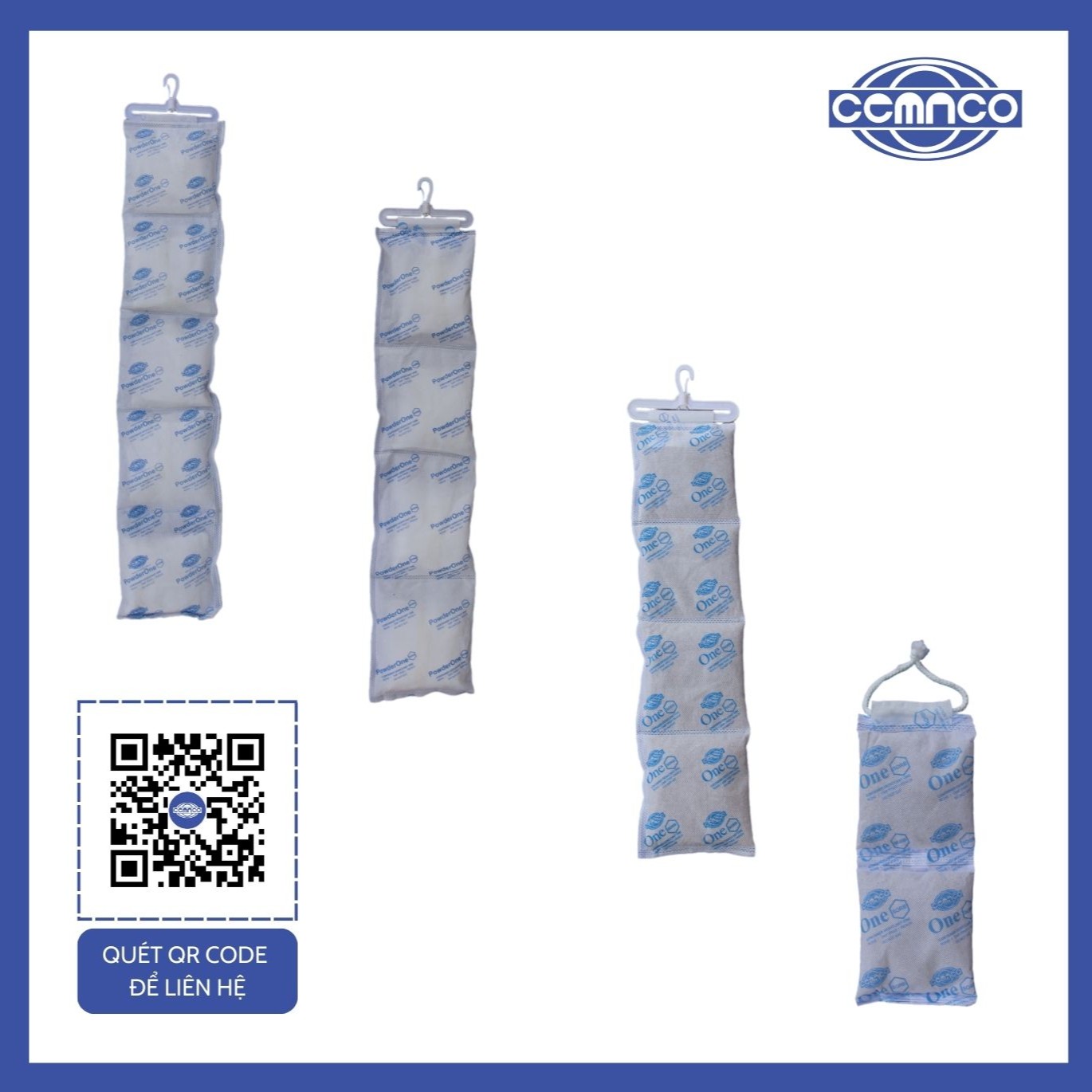
- 7 cargo types, 3 desiccant groups: Silica gel for electronics, pharmaceuticals, premium food; Clay for timber, apparel, machinery; CaCl₂ powder for long-haul tropical routes and heavy moisture-load cargo.
- Quick rule: Target RH < 40% → silica gel; target RH 40–65% → clay; route > 30 days + tropical → CaCl₂ or a layered combination.
- Base quantity: 0.05–0.08 kg/m³ for dry cargo; ×1.5 for fresh or high-MC cargo. 20ft container (33 m³) ≈ 2–3 kg; 40ft (67 m³) ≈ 4–6 kg.
- CEMACO Sai Gon supplies all 3 types, ISO 9001 + HACCP certified. Request a quote now.
Why Does Each Cargo Type Require a Different Desiccant?
Not all cargo has the same moisture sensitivity. When selecting a container desiccant, three foundational factors determine which type and how much to use: moisture sensitivity (how quickly the cargo degrades when exposed to humidity), hygroscopicity (whether the cargo itself releases moisture into the container atmosphere), and packaging permeability (how well the packaging blocks moisture exchange).
Moisture sensitivity: Electronic circuits fail at RH > 60% within days. Kiln-dried timber tolerates RH up to 65–70% without immediate mold. Freeze-dried food collapses structurally if RH exceeds 30%. Each cargo type therefore requires a different target RH, and the desiccant must be selected and sized to maintain that target throughout the entire voyage.
Hygroscopicity of cargo: Green timber (MC 15–20%) is itself a moisture source, continuously releasing water vapor into the container atmosphere as temperature cycles. Green coffee beans and dried agricultural products also off-gas moisture during temperature swings. Metal machinery, by contrast, does not release moisture but corrodes rapidly upon contact with humid air. The same container volume may require 2–3 times more desiccant depending on cargo type.
Packaging permeability: Electronics sealed in heat-welded PE bags (WVTR < 0.01 g/m²/day) create isolated micro-environments — desiccant inside the bag matters more than desiccant hung in the container. Large machinery that cannot be sealed relies entirely on container-level desiccant to control the entire hold's RH.
These three factors, combined with transit time (15-day short haul vs. 45-day long haul) and climate corridor (equatorial tropics vs. dry North Atlantic), create a complex selection matrix. The decision matrix below consolidates practical guidance for the 7 most common cargo types in Vietnamese export.
Decision Matrix — 7 Cargo Types
The table below is a baseline guide. Adjust for specific routes, seasonal conditions, and actual cargo MC at the time of stuffing. See also comparison of 3 container shipping desiccants for detailed pros and cons.
| Cargo Type | Primary Desiccant | Recommended Spec | Quantity (kg / 40ft) | Special Notes |
|---|---|---|---|---|
| Sawn Timber / Flooring (MC 8–12%) |
Clay 1kg or CaCl₂ powder 1kg | Non-woven fabric bag with logo; hang-hook on container crossbar | 6–10 kg (clay) or 5–8 kg (CaCl₂) | Green timber MC >15% requires ×1.5; Northern Europe routes (target RH 40%) may need silica gel instead of clay |
| Canned / Sealed Food | Silica gel 100–500g inside each carton | E-grade silica gel in Tyvek or non-woven; HACCP-certified | 3–5 kg (inside cartons) + 2–3 kg hung in container | HACCP required; avoid clay for premium food; verify Tyvek pH neutrality |
| Electronics / Components (PCBs, ICs, screens) |
Silica gel 50–100g inside PE bags + 500g–1kg hung in container | Tyvek food-grade or non-woven + moisture indicator cards | 4–6 kg (total silica gel) | Target RH < 40%; heat-seal PE bags WVTR < 0.01; never use CaCl₂ (liquid leakage corrodes PCBs) |
| Apparel / Fabric / Footwear | Clay 50–100g per box; clay 500g hung in container | Non-woven or Tyvek bags; 1 sachet per carton | 4–7 kg (total clay) | Target RH 50–60%; avoid CaCl₂ — liquid residue can stain fabric; verify odor neutrality |
| Machinery / Metal Equipment | CaCl₂ powder 1kg + silica gel 500g combination | CaCl₂ bags hung on crossbar; silica gel placed near critical metal surfaces | 8–15 kg (routes > 30 days) | Add VCI paper for uncoated steel surfaces; CaCl₂ must hang — NEVER direct contact with metal |
| Chemicals / Industrial Raw Materials | Silica gel 500g–1kg (moisture-sensitive) or clay (stable chemicals) | Check compatibility with CaCl₂ before use | 4–8 kg depending on chemical type | Check product MSDS; some chemicals react with calcium chloride — consult CEMACO engineering team first |
| Agricultural Products (coffee, cashew, grains) |
Clay 500g–1kg hung in container; silica gel 50–100g inside liner bags | Non-woven bags with logo + hang-hook | 6–10 kg (depending on cargo MC at stuffing) | Cargo MC must be < 13% at loading; agricultural products off-gas CO₂ + moisture — measure MC before stuffing; use GrainPro bags where available |
Note: The table above applies to a standard 40ft container (67 m³). A 20ft container (33 m³) requires approximately 50% of the above quantities. A 40ft HC (76 m³) requires approximately 115%. See the m³ + RH formula guide for precise calculations by route.
Key Variables — Target RH and Shipping Route
The same cargo type in the same 40ft container can require 50–100% more desiccant depending on the shipping route. Two variables matter most: target RH and climate corridor characteristics.
Target RH by cargo and destination market:
- Timber to Northern Europe (Germany, Norway, Finland): Continental dry climate with climate-controlled warehouses. Target RH = 40–45%. Requires silica gel or higher-than-baseline clay quantity (+30%).
- Food to US East Coast (New York, Miami): Ambient RH 60–75% year-round. Target RH = 50–55%. Clay is sufficient; routes through the Panama Canal (tropical) require +20% volume.
- Electronics to Japan / South Korea: Standard target RH = 30–40%. Silica gel mandatory. Clay is not suitable.
- Intra-Asia routes (Vietnam–Thailand, Vietnam–Indonesia): Short 5–10 days but high ambient RH of 80–90%. Clay 500g is sufficient for standard cargo.
Tropical climate corridor — the invisible threat: Ships crossing equatorial zones (South China Sea, Indian Ocean, Gulf of Mexico) encounter container rain — condensation dripping from the container ceiling when day/night temperature differentials reach 10–15°C. For these routes, CaCl₂ powder with an absorption capacity of 1.0–2.0 kg moisture/kg desiccant (3–5 times higher than silica gel) offers the best cost-to-performance ratio. Testing standards for transit packaging performance can be referenced from ISTA (International Safe Transit Association).
Combining 2–3 Desiccant Types in One Container
The layered defense strategy — combining 2–3 desiccant types — is used by professional exporters to optimize cost while maintaining comprehensive protection. Instead of a single product, you deploy each type where its strengths are most useful across different voyage phases.
Example: 3-layer strategy for timber shipped to the US:
- Layer 1 — Clay 500g × 20 bags hung on crossbars: Controls overall container RH during the first 15 days. Lowest cost, sufficient while RH changes gradually.
- Layer 2 — CaCl₂ powder 1kg × 5 bags hung alongside: Activates when RH spikes above 65% (days 10–25 through tropical waters). High absorption capacity handles peak humidity rapidly.
- Layer 3 — Silica gel 100g sachets inside each unit pack: Protects the micro-environment around individual timber pieces, especially exposed cross-cut ends that absorb moisture most quickly.
This 3-layer system typically costs 20–30% less than using premium silica gel throughout, while providing better protection than clay alone. See silica gel vs clay in detail and silica gel vs CaCl₂ for the mechanism behind each type. For mixed-product orders, CEMACO Sai Gon accepts a combined MOQ of 100kg across all SKUs with no separate per-SKU minimum.
Common Mistakes When Choosing Container Desiccants
Based on experience serving thousands of export shipments, CEMACO Sai Gon has identified the 5 most common errors that lead to cargo damage despite using desiccants:
- Underdosing — using too little: Estimating by habit rather than calculating from m³ + RH data. Result: desiccant saturates before the ship reaches the destination port. Solution: use the detailed calculation table and apply a safety bias of ×1.2.
- Overdosing CaCl₂ for chemically sensitive cargo: Saturated CaCl₂ produces liquid calcium chloride solution. If bags tear or are improperly positioned, this liquid contacts electronics, fabric, or food and causes severe damage. Use CaCl₂ only for compatible cargo types.
- Fake or low-quality Tyvek packaging: Genuine DuPont Tyvek allows water vapor to pass through while blocking dust and bacteria. Counterfeit "Tyvek" made from woven PE seals its pores when wet — the desiccant inside cannot absorb moisture from the container atmosphere. Verification: genuine Tyvek is breathable, water-resistant, and slightly translucent under bright light.
- Placing desiccant in the wrong position: Desiccant must be hung near the container ceiling (where moisture concentrates) and distributed evenly along both walls and the center. Placing desiccant on the floor or buried under cargo reduces effectiveness by 40–60%. A 40ft container needs at least 6–8 hanging points.
- Not measuring cargo MC before stuffing: Timber at MC 20% stuffed into a container sized for MC 8–12% will saturate desiccant twice as fast as calculated. Use a moisture meter to measure cargo MC before stuffing and adjust desiccant quantity accordingly.
Frequently Asked Questions
What type of desiccant does a 40ft container need?
A 40ft container (67 m³) typically uses silica gel 1kg × 60–80 bags or clay 1kg × 70–90 bags for standard dry cargo. Sensitive cargo (electronics, pharmaceuticals) requires premium silica gel; timber and apparel shipments can use clay or CaCl₂ powder for routes exceeding 30 days. See the m³ + RH formula for precise sizing.
Do timber and electronics shipments use the same desiccant?
No. Timber (MC 8–12%) tolerates RH up to 60–65%, so clay or silica gel in 500g–1kg units is sufficient. Electronics require RH < 40% — premium silica gel is mandatory, combined with moisture-barrier PE bags and moisture indicator cards for continuous monitoring.
What cargo types is CaCl₂ suitable for?
CaCl₂ (calcium chloride powder desiccant) is best suited for containers on long-haul routes exceeding 30 days through tropical regions, timber, machinery, and non-chemically-sensitive cargo. Avoid CaCl₂ for unsealed food, electronics, or thin metal products — the liquid released upon saturation can cause corrosion and product damage.
How long does a container to the US take and what desiccant is needed?
Vietnam to US East Coast takes 25–35 days; US West Coast 18–22 days. For routes exceeding 25 days across the Pacific, we recommend silica gel 1kg + CaCl₂ powder 1kg distributed evenly throughout the container to handle humidity peaks in tropical waters. Visit the container industry page for route-specific advice.
Can I order silica gel, clay, and CaCl₂ powder together in one order?
Yes. CEMACO Sai Gon accepts mixed orders with a combined minimum of 100kg across all product types, with no separate per-SKU MOQ. Contact hotline 0983 929 232 or submit the form at our quote page to receive a consolidated price list and product combination recommendations.
Read more — flagship article: Comprehensive Comparison: Silica Gel vs Clay vs CaCl₂ 2026 — detailed analysis of 15 technical criteria + 7-step decision tree + 5-industry TCO for picking the right desiccant per shipment.
Not sure which type is right for your specific shipment?
CEMACO Sai Gon's technical team provides free consultation by route and cargo type. 24/7 hotline: 0983 929 232.
Request a Quote + Free ConsultationNeed a quote based on this article?
The CEMACOSG technical team provides free consultation on desiccant quantity tailored to your cargo, route, and export requirements.