
How Much Desiccant for One Container? m³ + RH Formula
Step-by-step formula to calculate desiccant quantity for shipping containers by volume (m³) and relative humidity. Quick lookup tables for 20ft (33 m³) and 40ft (67 m³) containers by cargo type — timber, food, electronics — with worked examples and a safety bias of ×1.2.
- Formula: kg desiccant = V (m³) × ΔRH × coefficient (0.04–0.08) × safety bias (1.2).
- 20ft container (33 m³) dry cargo: recommend 1.5–3 kg silica gel or 2–4 kg clay.
- 40ft container (67 m³) dry cargo: recommend 3–6 kg silica gel or 4–8 kg clay.
- Fresh / high-MC cargo → multiply ×1.5. Long tropical route → increase 20–30% or add CaCl₂.
- Request a quote — 24/7 hotline: 0983 929 232.
The Container Desiccant Calculation Formula
The question "how much desiccant for one container?" has no fixed answer — the quantity varies based on container volume, cargo type, ambient RH at the origin and destination, and transit duration. However, a technical formula standardized across the international desiccant industry provides a reliable approximation:
Base formula:
kg desiccant = V (m³) × ΔRH × K × S
Where:
- V = container internal volume (m³). Standard 20ft = 33 m³; 40ft = 67 m³; 40ft HC = 76 m³.
- ΔRH = RH differential to control = RH at loading minus target RH at destination. Example: loading in Ho Chi Minh City (RH 80%), destination Northern Europe (target RH 40%) → ΔRH = 0.80 − 0.40 = 0.40.
- K = desiccant absorption coefficient (kg moisture absorbed per kg desiccant):
- Silica gel: K = 0.25–0.40 (absorbs 25–40% of own weight)
- Clay: K = 0.20–0.30
- CaCl₂ powder: K = 1.0–2.0 (highest — chemical reaction forms liquid solution)
- S = safety bias. Standard S = 1.2 (20% above theoretical). Routes > 30 days or tropical corridors: S = 1.3–1.5.
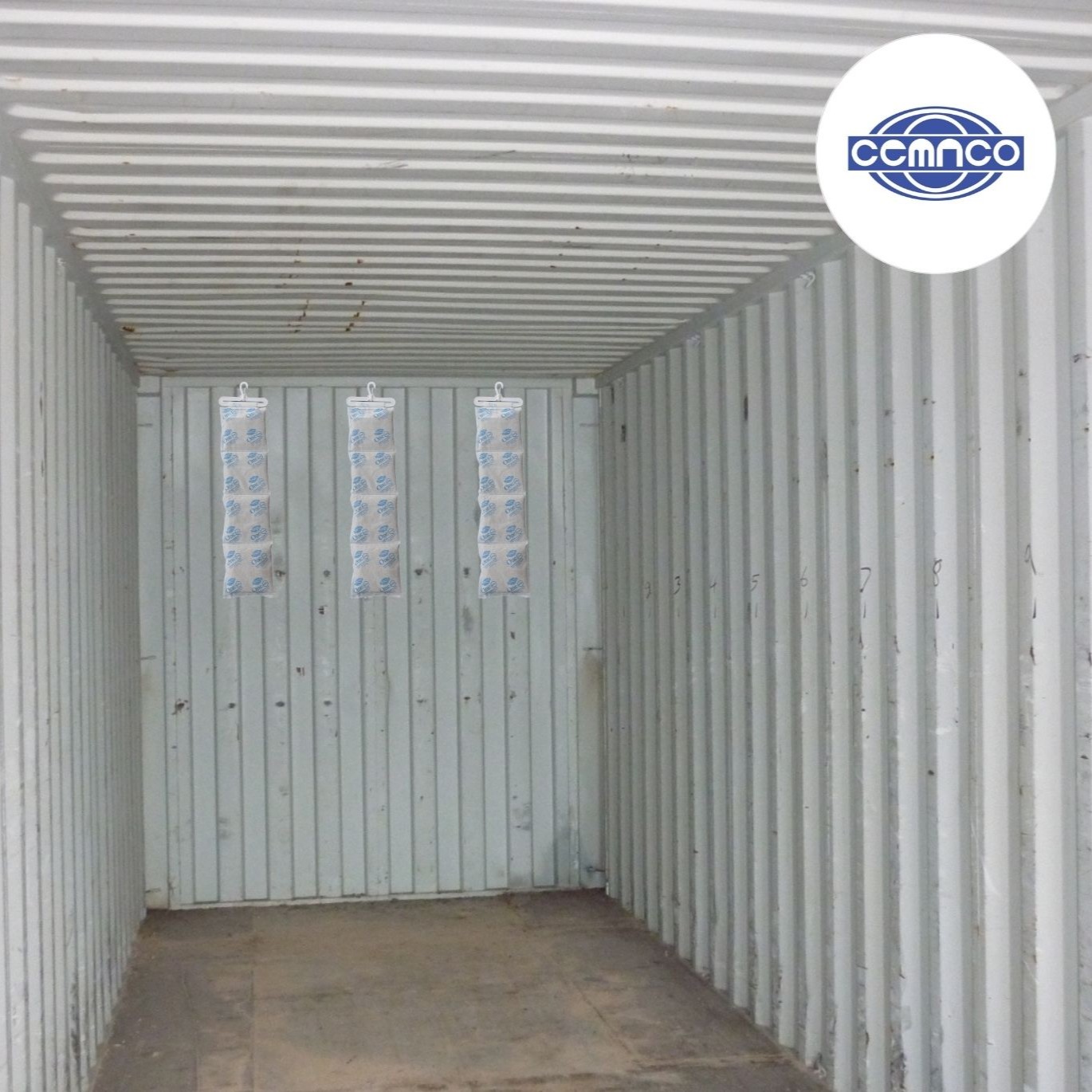
Quick example — 40ft timber container to Northern Europe: V = 67 m³; ΔRH = 0.40; k’ = 0.06; S = 1.2 → silica gel = 67 × 0.40 × 0.06 × 1.2 = 1.93 kg theoretical. Practical recommendation: round up to 2.5–3 kg to cover 8 hanging points (one or two 500g bags per crossbar position).
Note: this formula calculates the theoretical minimum. In practice, container door openings at transshipment ports, seal leakage through aged door gaskets, and daytime temperature peaks all increase effective moisture load. See the detailed cargo type calculation table for faster reference.
Quick Lookup Table — 20ft Container (33 m³)
The table below applies the formula above with S = 1.2 and typical ΔRH per cargo type, representing practical recommended quantities, not theoretical minimums. Use the desiccant selection decision matrix to confirm the right product type before sizing the quantity.
| Cargo Type | Target RH | Silica Gel (kg) | Clay (kg) | CaCl₂ Powder (kg) |
|---|---|---|---|---|
| Dry Timber (MC 8–12%) | 45–55% | 1.5–2.0 | 2.0–3.0 | 1.0–1.5 |
| Green Timber (MC 15–20%) | 45–55% | 2.5–3.5 | 3.5–5.0 | 1.5–2.5 |
| Canned / Sealed Food | 50–60% | 1.5–2.5 | 2.0–3.5 | Not recommended |
| Electronics / Components | 35–40% | 2.5–4.0 | Not recommended | Not recommended |
| Apparel / Fabric | 50–60% | 1.5–2.5 | 2.0–3.0 | Not recommended |
Applies to 15–25 day transit routes, cargo loaded in Vietnam (RH 70–85%). Routes > 25 days: increase quantities by 20–30%.
Quick Lookup Table — 40ft Container (67 m³)
A 40ft container has a larger internal surface area and requires desiccant distributed across more hanging points (minimum 6–8 points) to ensure even RH control. With silica gel 1kg or clay 1kg bags fitted with hanging hooks, placing 1–2 bags per crossbar position is practical. See container rain — the phenomenon to control to understand why the container ceiling is the most critical placement zone.
| Cargo Type | Target RH | Silica Gel (kg) | Clay (kg) | CaCl₂ Powder (kg) |
|---|---|---|---|---|
| Dry Timber (MC 8–12%) | 45–55% | 3.0–4.5 | 4.0–6.0 | 2.0–3.5 |
| Green Timber (MC 15–20%) | 45–55% | 5.0–7.5 | 7.0–10.0 | 3.5–5.5 |
| Canned / Sealed Food | 50–60% | 3.0–5.0 | 4.0–7.0 | Not recommended |
| Electronics / Components | 35–40% | 5.0–8.0 | Not recommended | Not recommended |
| Apparel / Fabric | 50–60% | 3.0–5.0 | 4.0–6.5 | Not recommended |
| Machinery / Metal Equipment | 40–55% | 4.0–6.0 (+ CaCl₂) | 5.0–8.0 (+ CaCl₂) | 4.0–8.0 |
Applies to 20–35 day transit routes. 40ft HC container (76 m³): multiply all values by 1.13.
Worked Examples for 3 Industries
The three examples below show how to apply the formula and lookup tables to the most common real-world export scenarios from Vietnam. Cross-reference the standard silica gel size chart to select the right bag specification.
Example 1 — Hardwood Flooring Exported to Northern Europe (Target RH 40%)
- Container: 40ft, 67 m³
- Cargo: Kiln-dried acacia flooring, MC 10%
- RH at HCMC loading point: 80%
- Target RH: 40% (climate-controlled Northern European warehouse)
- ΔRH: 0.80 − 0.40 = 0.40
- Route: HCMC → Rotterdam, ~28 days via Indian Ocean
- Calculation: 67 × 0.40 × 0.06 × 1.3 (route > 25 days) = 2.09 kg theoretical
- Practical recommendation: Clay 500g × 8 bags = 4 kg (hung on crossbars) + silica gel 100g × 20 bags = 2 kg (placed inside individual timber packs)
- Rationale: Clay is cost-effective for dry timber; small silica gel sachets protect exposed cross-cut ends that absorb moisture most quickly; total 6 kg exceeds the theoretical minimum to buffer against humidity peaks crossing the Indian Ocean.
Example 2 — Packaged Food Exported to the US (Target RH 55%)
- Container: 40ft, 67 m³
- Cargo: Salted roasted cashews in hermetically sealed cans
- RH at Cat Lai port loading: 75%
- Target RH: 55% (US warehouses typically climate-controlled)
- ΔRH: 0.75 − 0.55 = 0.20
- Route: HCMC → Los Angeles, ~22 days
- Calculation: 67 × 0.20 × 0.05 × 1.2 = 0.80 kg theoretical
- Practical recommendation: Silica gel 100g HACCP-grade × 30 bags = 3 kg (inside cartons, 1 bag per carton) + clay 500g × 4 bags = 2 kg (hung in container)
- Rationale: Food cargo requires HACCP certification — E-grade silica gel is food-safe. Actual quantity is higher than theoretical because 1 bag per carton is needed to protect each box's micro-environment regardless of container-level RH.
Example 3 — Electronics Components Exported to Japan (Target RH 30%)
- Container: 20ft, 33 m³
- Cargo: PCB assemblies packed in heat-sealed PE bags
- RH at factory air-conditioned packing room: 65%
- Target RH: 30% (Japanese electronics warehouse standard)
- ΔRH: 0.65 − 0.30 = 0.35
- Route: HCMC → Yokohama, ~10 days
- Calculation: 33 × 0.35 × 0.08 × 1.2 = 1.11 kg theoretical
- Practical recommendation: Silica gel 50g × 30 bags = 1.5 kg (inside each PE bag) + silica gel 500g × 4 bags = 2 kg (hung in container) = 3.5 kg total
- Rationale: Short route but very low target RH — silica gel only throughout. Most desiccant is placed inside the PE bag barrier; container-level desiccant provides secondary protection if any bag is punctured. Confirm silica gel is the correct type via the decision matrix.
Adjustment Factors — Transit Time, Climate, Cargo MC
The base formula gives accurate results under "ideal" conditions. Three groups of real-world factors require adjustment:
1. Transit time:
- Transit < 15 days: S = 1.1 (fewer temperature cycles)
- Transit 15–30 days: S = 1.2 (standard)
- Transit > 30 days: S = 1.3–1.5 or supplement with CaCl₂
2. Climate corridor:
- Routes crossing the equator, Indian Ocean, or tropical Pacific: increase desiccant by 20–30% or switch to CaCl₂ for peak humidity management. The Cargo Incident Notification System (CINS) consistently identifies moisture and mold as the leading cause of container cargo damage on tropical routes.
- North Atlantic / Northern Europe routes (dry, cold): reduce by 10–15%.
- Intra-Asia routes < 10 days: use the minimum values from the lookup tables.
3. Cargo moisture content (MC) at time of stuffing:
- Standard dry cargo (MC ≤ 12%): use lookup tables directly.
- MC 12–18%: multiply by 1.3.
- MC > 18% (green timber, insufficiently dried agricultural produce): multiply by 1.5 or reject for container loading until properly dried.
Frequently Asked Questions
What coefficient (kg/m³) does the desiccant formula use?
The simplified practical formula is: kg desiccant = V (m³) × ΔRH × k’ × S. The combined coefficient k’ = 0.04–0.06 for low-sensitivity dry cargo (dry timber, apparel); 0.06–0.08 for sensitive cargo (electronics, pharmaceuticals). Safety bias S = 1.2 standard; S = 1.3–1.5 for routes > 30 days through tropical regions. See the detailed cargo calculation table for quick reference.
How many kg of desiccant does a 20ft container need?
A 20ft container (33 m³) carrying standard dry cargo needs 1.5–3 kg silica gel or 2–4 kg clay for routes of 15–25 days. Electronics cargo requires 2.5–4 kg silica gel only. Green timber requires 2.5–3.5 kg silica gel or 3.5–5 kg clay.
How many kg of desiccant does a 40ft container need?
A 40ft container (67 m³) carrying standard dry cargo needs 3–6 kg silica gel or 4–8 kg clay. Electronics cargo requires 5–8 kg silica gel. Green timber requires 5–7.5 kg silica gel or 7–10 kg clay. For routes exceeding 30 days through tropical regions, add 2–5 kg CaCl₂ powder to handle humidity peaks.
Is the calculation for fresh timber different from dry timber?
Yes — significantly different. Green timber (MC 15–20%) continuously releases moisture into the container atmosphere throughout the voyage. The required desiccant quantity is multiplied by ×1.5 compared to standard dry timber. Measure cargo MC with a moisture meter before stuffing — if MC exceeds 18%, either re-dry before export or substantially increase desiccant quantity and accept elevated risk.
Can I order partial quantities below the per-SKU MOQ?
Yes. CEMACO Sai Gon applies a combined MOQ of 100kg total weight across mixed orders of silica gel, clay, and CaCl₂ powder, with no separate minimum per SKU. This is ideal when you need a custom combination for a specific container and cargo type. Contact hotline 0983 929 232 or submit a request at our quote page for a consolidated price list.
Read more — flagship article: Comprehensive Comparison: Silica Gel vs Clay vs CaCl₂ 2026 — moisture capacity tables by RH × temperature, blended loading formula (silica + clay + CaCl₂) for 20ft + 40ft + 40ft HC containers.
Need a precise desiccant calculation for your specific shipment?
Send us your cargo type, container size, and shipping route — CEMACO Sai Gon's technical team will provide a calculation and quote within 2 business hours. 24/7 hotline: 0983 929 232.
Request Technical Consultation + QuoteNeed a quote based on this article?
The CEMACOSG technical team provides free consultation on desiccant quantity tailored to your cargo, route, and export requirements.