
What Is Container Rain? 5 Causes of Condensation and How to Prevent It
Container Rain is the condensation of moisture on container walls caused by day/night temperature swings during ocean voyages. Learn the dew point physics, 5 root causes, and effective CaCl₂ desiccant strip + silica gel solutions.
TL;DR — Summary
Container Rain is the condensation of moisture on the interior walls and ceiling of a shipping container caused by temperature swings during multi-timezone ocean voyages. Warm, humid air inside the container reaches its dew point when steel walls cool at night, releasing water droplets that fall onto cargo below — like a miniature rainstorm. The most effective prevention: hang 3–4 calcium chloride desiccant strips along the container walls combined with 4–6 kg of silica gel packets distributed across pallets, keeping relative humidity below 60% RH throughout transit. Applicable to all export cargo: coffee, timber, garments, electronics, footwear.
What Is Container Rain?
Container Rain — also known as "container sweat" or "cargo sweat" — is the phenomenon of moisture condensing as liquid water droplets on the interior metal surfaces of a shipping container when the steel temperature falls below the dew point of the enclosed air. These droplets accumulate on walls, ceiling, and door frames, then drip down onto cargo — creating a damaging "rain shower" inside the sealed unit.
The insidious nature of Container Rain lies in its invisibility: it occurs silently over 15–45 day voyages with no external signs. Damage is only discovered at the destination port, when goods are already compromised beyond recovery.
According to the World Shipping Council, moisture-related damage is consistently among the top causes of cargo loss claims in international ocean freight, representing significant insurance costs across the global shipping industry each year.
The Physics of Container Rain — Dew Point Explained
Three physical concepts underpin Container Rain:
Relative Humidity (RH): The percentage of actual moisture in air relative to the maximum moisture air can hold at that temperature. Air at 30°C/80% RH contains far more absolute moisture than air at 20°C/80% RH.
Dew Point: The temperature at which air reaches 100% RH and water vapor begins condensing. For example, air at 30°C/80% RH has a dew point of approximately 26.2°C. If the container wall surface cools below 26.2°C, condensation begins immediately on metal surfaces.
ASHRAE Psychrometric Reference: The ASHRAE psychrometric chart enables precise dew point and absolute humidity calculations across temperature-RH combinations — a standard tool for packaging engineers designing moisture control solutions for international shipping.
The Container Rain formation sequence:
- Container is packed at a tropical port (30–35°C, 75–90% RH — typical Vietnam conditions).
- Cargo itself (timber, agricultural products, cardboard packaging) continues releasing moisture into the sealed space.
- The vessel transits through ocean zones with 15–25°C day-to-night temperature swings.
- Steel container walls (2–3 mm thick) conduct heat rapidly — interior wall surface temperature approaches ambient outdoor temperature within hours.
- Humid interior air contacts the cooled wall surface → reaches dew point → condensation forms immediately.
- Droplets accumulate, run down walls, and drip from the ceiling onto cargo below.
- Daytime warming evaporates the condensate → relative humidity spikes again → the cycle repeats 1–2 times per day throughout the voyage.
5 Primary Causes of Container Rain
- High initial moisture content in cargo: Sawn timber (MC 12–18%), green coffee (MC 11–13%), black pepper (MC 12%), leather goods (MC 8–12%), damp cardboard packaging. These materials continue releasing vapor throughout transit, raising container RH from 60% to 85–95%.
- Packing in high-humidity conditions: Unpacked warehouses during afternoon rain (RH 80–90%). Cargo packed under these conditions carries large moisture loads into the sealed container from day one.
- Multi-timezone routes with large temperature differentials: Vietnam → Europe, Vietnam → Japan, Vietnam → US East Coast routes all experience 15–25°C day-night temperature swings and transition from tropical to temperate climate zones.
- Rainy season or winter shipping: May–November from Vietnam, November–March in Japan/Korea/Northern Europe — when day-night temperature extremes increase sharply as vessels move from tropical to cold regions.
- Aging containers with air infiltration: Containers over 10 years old often have worn door gaskets and small floor or wall perforations. Continuous infiltration of exterior humid air overwhelms the desiccant capacity over a long voyage.
Consequences: 7 Common Damage Types
| Damage Type | Industry | Frequency | Estimated Cost/Container |
|---|---|---|---|
| Surface mold on cargo | Timber, food, garments | Very common | USD 500 – 3,000 |
| Rust/corrosion on electronics or metal components | Electronics, machinery | Common | USD 1,000 – 10,000 |
| Damaged labels and cardboard packaging | All industries | Very common | USD 200 – 1,500 |
| Warping and delamination of timber/furniture | Timber, furniture | Common | USD 2,000 – 15,000 |
| Discoloration and yellowing of textiles | Garments, footwear | Common | USD 1,000 – 8,000 |
| Flavor degradation of coffee and spices | Food & beverage | Frequent | USD 500 – 5,000 |
| Cargo rejection at destination port | Food, timber | Occasional | USD 5,000 – 50,000 |
4 Effective Solutions to Prevent Container Rain
No single product eliminates Container Rain for all cargo types. The optimal strategy combines multiple protective layers based on cargo hygroscopicity and voyage route.
Solution 1 — Calcium Chloride Desiccant Strips (Hanging Bags):
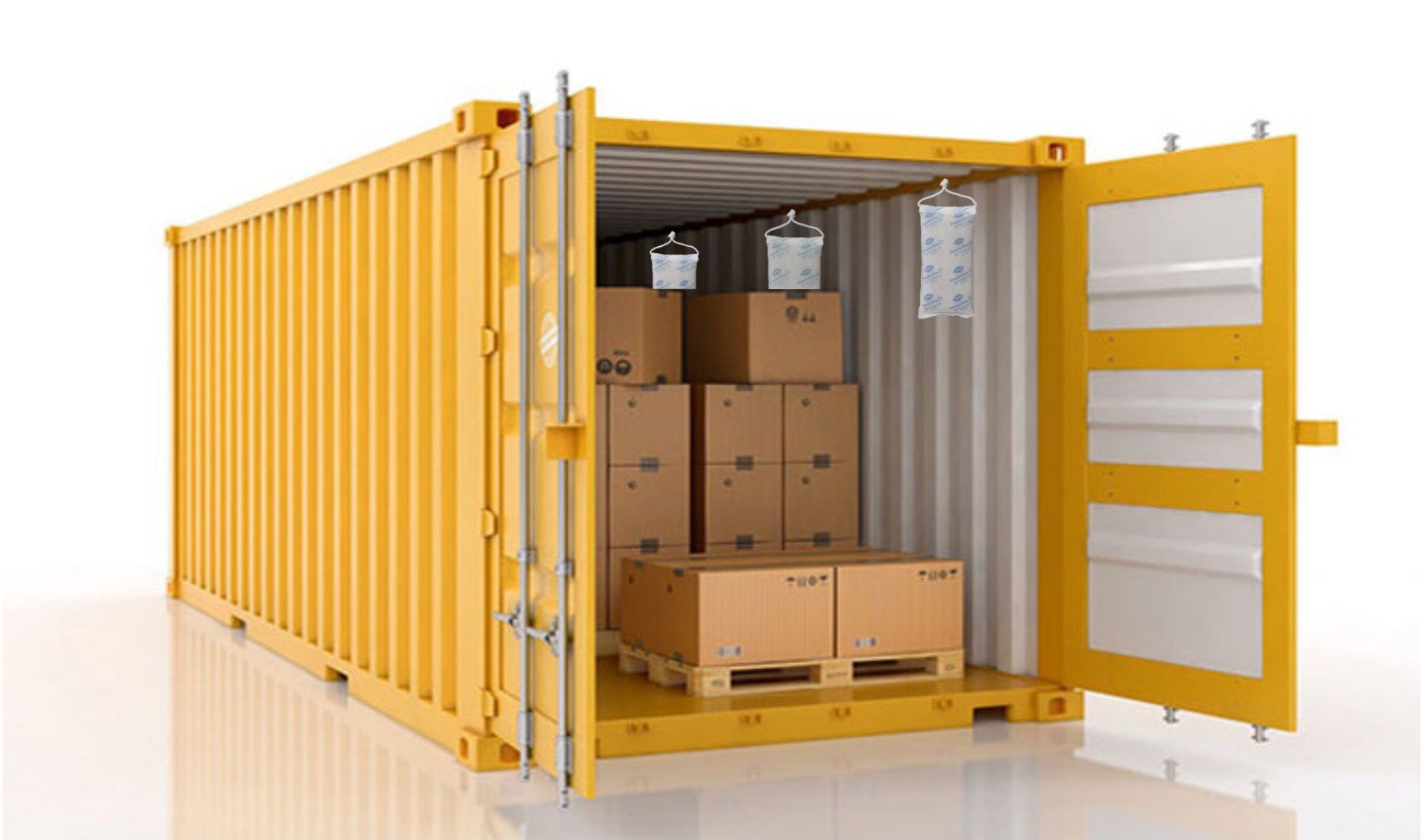
CaCl₂ is a deliquescent desiccant — it absorbs moisture and converts it into a saline solution that cannot release vapor back into the container. Absorption capacity reaches 200–300% of the strip's own weight. Each 1–1.2 kg strip hung vertically on a container wall can process 200–300 g of moisture per day at 80% RH.
Standard specification: 3–4 strips for 20-foot containers, 6–8 strips for 40-foot containers. View product details at CEMACO calcium chloride desiccant.
Solution 2 — Silica Gel Packets on Pallets:
500g–1,000g silica gel packets distributed across pallets or inserted into cartons control localized humidity around the cargo itself. Ideal for electronics, packaged food, and pharmaceuticals requiring tight humidity control below 50% RH. Combine with CaCl₂ strips for two-layer protection: macro (whole container) + micro (around pallets/cartons).
Solution 3 — Container Desiccant Liner Bags:
PE liner bags with integrated silica gel or CaCl₂ wrap the entire container interior, creating a climate-controlled space fully isolated from the steel walls. Higher cost, best suited for ultra-moisture-sensitive cargo (specialty coffee, cocoa, medical devices).
Solution 4 — Pre-conditioning Cargo Before Packing:
Dry cargo (timber, cardboard, pallets) to target moisture content (timber ≤ 12%, cardboard ≤ 8%) before container loading. Pack in an air-conditioned warehouse maintaining RH ≤ 60%. This addresses the moisture source directly, reducing total container moisture by 40–60% — the most cost-effective intervention when properly executed.
Quick Reference: Cargo Type vs Recommended Solution
| Cargo Type | Container Rain Risk | Recommended Kit | Quantity / 20-foot Container |
|---|---|---|---|
| Green coffee beans | Very high | CaCl₂ strips + silica gel on pallets | 4 strips × 1.2 kg + 6 kg silica gel |
| Sawn timber, plywood | Very high | CaCl₂ strips + pre-conditioning | 4–6 strips × 1.2 kg |
| Garments and footwear | High | CaCl₂ strips + silica gel per carton | 3 strips × 1 kg + 50g/carton |
| Electronics, components | High | Silica gel on pallets + CaCl₂ strips | 2 strips × 1 kg + 8–12 kg silica gel |
| Pepper, dry spices | Medium–high | CaCl₂ strips | 3 strips × 1 kg |
| Ceramics, handicrafts | Medium | CaCl₂ strips or silica gel | 2 strips × 1 kg or 4 kg silica gel |
10-Step Container Packing Checklist to Prevent Container Rain
- Inspect the container before loading: Shine a flashlight inside in darkness — visible light through seams means air infiltration. Reject and request a replacement container.
- Measure warehouse RH: Use a hygrometer. If RH > 65%, activate air conditioning or pack early morning when ambient RH is lower.
- Check cargo moisture content: Use a moisture meter — timber ≤ 12%, cardboard ≤ 8%, agricultural products per industry standard.
- Use dry, clean pallets: Reject damp, moldy, or fresh-cut timber pallets (MC > 15%).
- Install CaCl₂ desiccant strips: Hang vertically along the long walls, 30–40 cm above floor, spaced 1.5–2 m apart — see strip installation guide.
- Distribute silica gel packets across pallets: Place between cargo layers and on top of each pallet. Use 500g–1,000g packets per position.
- Seal the container immediately: Close and seal within 30 minutes of loading completion to prevent additional humid air entry.
- Log the packing record: Date, warehouse RH, desiccant type and quantity, container number — essential documentation for insurance claims.
- Calculate correct desiccant quantity: Use route-specific and cargo-specific tables — see the container desiccant calculator.
- Review outcome data post-voyage: Check CaCl₂ strip saturation level upon arrival. Fully saturated strips mean higher-than-expected RH — increase quantity for the next shipment.
When Should You Revise Your Moisture Control Solution?
- CaCl₂ strips fully saturated before cargo reaches destination — increase strip count or upgrade to higher-capacity strips.
- Mold spots still appear despite desiccant use — check incoming cargo MC; pre-conditioning may be required.
- Container is older than 10 years — inspect door gaskets and increase desiccant quantity by 50% to account for air infiltration.
- Route changes (added transshipment port) — longer transit time requires proportionally more desiccant.
- Switching to more moisture-sensitive cargo (e.g., from timber to electronics) — upgrade to precision silica gel moisture control rather than CaCl₂ alone.
Frequently Asked Questions about Container Rain
Does Container Rain occur in refrigerated (reefer) containers?
Reefer containers control temperature but not humidity. If cargo is loaded at high RH and the reefer lacks dehumidification capability, Container Rain can still occur when the setpoint temperature falls below the dew point of the interior air. Always measure RH before closing reefer units.
Is standard silica gel sufficient to prevent Container Rain?
Not for high-moisture-emitting cargo (timber, agricultural products). Silica gel works best at lower RH levels (< 60%) and saturates rapidly at high RH. The most effective approach combines CaCl₂ strips (macro moisture removal) with silica gel packets (precision micro-humidity control around cargo).
How many desiccant strips are needed for a 40-foot container?
A 40-foot container (67 m³) requires 6–8 CaCl₂ desiccant strips of 1–1.2 kg each for standard cargo. High-emission cargo (fresh-cut timber, coffee, agricultural goods) requires 8–10 strips. Calculate precisely using the container desiccant calculator.
Can CaCl₂ desiccant strips leak and damage cargo?
Quality desiccant strips use multi-layer non-woven fabric combined with Super Absorbent Polymer (SAP) that gels the CaCl₂ solution — preventing leakage entirely. When sourcing, request a leak test certificate and inspect the SAP gel sample. CEMACO Sài Gòn conducts 100% leak testing before dispatch.
Can Container Rain occur while containers are waiting at the port before loading?
Yes. A container sitting on an outdoor port terminal overnight (cooling) after a hot packing day is an ideal environment for Container Rain to begin before the vessel even departs. Install desiccant immediately upon packing — do not wait until the container is loaded onto the ship.
Read more — flagship article: Container Rain — Complete Anti-Condensation Handbook 2026 — dew point physics, 5 root causes, desiccant calculation formulas for 20ft + 40ft, and 3 real-world CEMACO case studies.
Need expert advice on the right desiccant quantity for your export shipment?
CEMACO Sài Gòn's technical team provides free consultation — cargo analysis, route assessment, and tailored solution recommendation.
Request a quote and consultation — Hotline +84 983 929 232 (24/7)
Need a quote based on this article?
The CEMACOSG technical team provides free consultation on desiccant quantity tailored to your cargo, route, and export requirements.