What Is Silica Gel? Composition, Uses and 7 Common Types in 2026
What is silica gel? Learn its SiO₂·nH₂O composition, adsorption mechanism, 7 common types and uses in container, food and electronics industries. Expert guide 2026.
TL;DR — Summary
Silica gel is a synthetic, granular desiccant composed of silicon dioxide (SiO₂·nH₂O). Its porous structure provides a BET surface area of 600–800 m²/g, enabling absorption of 35–40% of its dry weight in moisture. Seven main types exist as of 2026: White Type A/B, Blue indicator (CoCl₂), Orange indicator (iron oxide), Pellet/Bead, Tyvek bags and non-woven (KD) bags. It is used across five industries — container shipping, food, wood, electronics and garments — and meets FDA 21 CFR 184.1711 (GRAS) and ISO 9001 standards.
What Is Silica Gel?
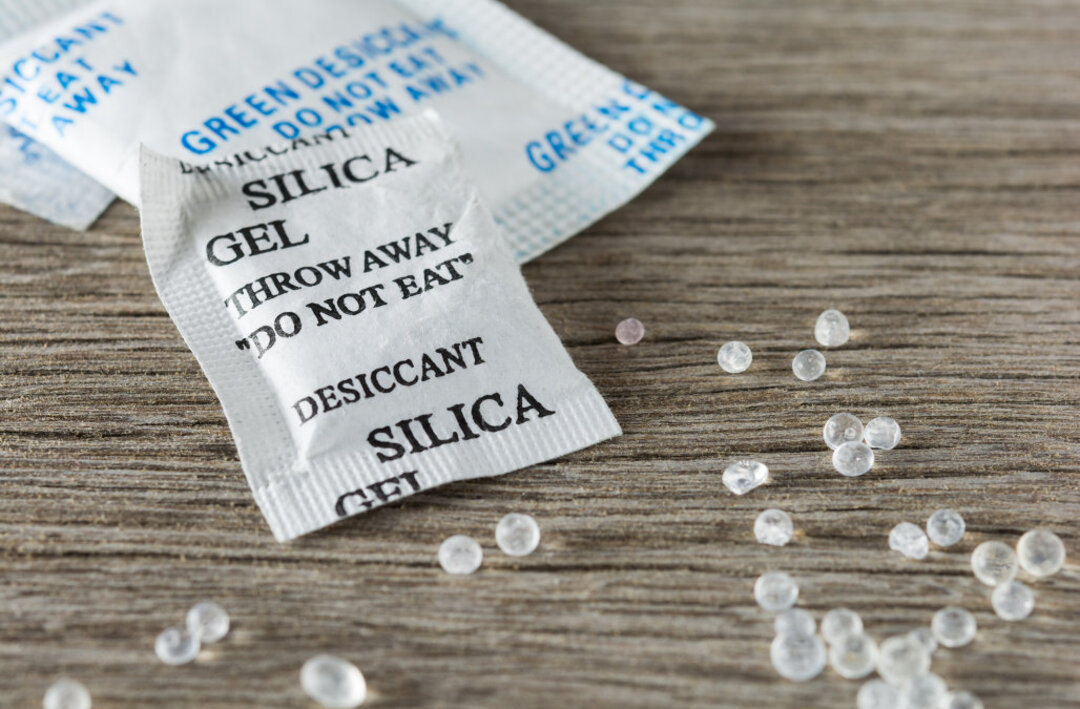
Silica gel is a synthetic amorphous form of silicon dioxide (SiO₂), manufactured by reacting sodium silicate with sulfuric acid, then drying and granulating the resulting gel. Despite the name "gel," the final product is a rigid solid — the term reflects an intermediate gel phase during production.
Its chemical formula is SiO₂·nH₂O, where n represents water molecules physically bound within the pore network. The material is chemically inert, non-toxic per FDA standards, non-reactive with most chemicals and non-corrosive under normal operating conditions.
Commercially, industrial silica gel desiccant is sold as granules or powder packed in Tyvek paper, non-woven (KD) fabric, or OPP film pouches. A 50 g pouch placed inside a carton or shipping container can protect goods from mold throughout a 30–45 day ocean voyage.
Composition and Moisture Absorption Mechanism
Silica gel features a three-dimensional pore network with an average pore diameter of approximately 2.4 nm (Type A) or 4.5–7.5 nm (Type B). The BET surface area measures 600–800 m²/g — meaning 1 gram of silica gel has a total contact surface equivalent to several football pitches.
Moisture uptake occurs by physical adsorption (physisorption), not a chemical reaction, through two phenomena:
- Capillary condensation: At low relative humidity (RH), water vapor condenses inside narrow pores via van der Waals forces, analogous to capillary rise in narrow tubes.
- Multilayer adsorption: As RH increases, successive layers of water molecules stack on silanol (Si–OH) surface sites.
The process is reversible: heating at 110–130°C for 2–3 hours drives off adsorbed moisture, restoring the silica gel to its dry state for reuse. Maximum adsorption reaches 35–40% of dry weight at RH 90%, while practical uptake under typical storage conditions (RH 40–70%) is 10–20%. Learn more: how to regenerate silica gel by drying.
7 Common Types of Silica Gel in 2026
Seven main types serve different applications and budgets:
| Type | Particle Size | Max Adsorption (%) | Indicator | Main Applications |
|---|---|---|---|---|
| White Type A (small pore) | 2–5 mm | 35–40% | None | Food, pharma, electronics |
| White Type B (large pore) | 3–8 mm | 30–35% | None | Catalysts, chromatography, heavy industry |
| Blue Indicator (CoCl₂) | 2–5 mm | 35–40% | Blue → Pink | Equipment, labs (restricted in EU) |
| Orange Indicator (iron oxide) | 2–5 mm | 35–38% | Orange → Green | Food, EU/Japan export |
| Pellet / Bead | 1–3 mm | 30–37% | Optional | Industrial dehumidifiers, chromatography |
| Tyvek Paper Pouch | Pre-packed 1g–100g | 35–40% | Varies | Containers, food, electronics |
| Non-woven (KD) Pouch | Pre-packed 50g–1,000g | 35–40% | Varies | Containers, wood, garments, large warehouses |
Important note: Blue indicator silica gel contains cobalt(II) chloride (CoCl₂), classified as an SVHC (Substance of Very High Concern) under EU REACH. European and Japanese markets are transitioning to orange indicator (iron oxide). See also: silica gel color change blue-pink — mechanism and saturation testing.
Applications Across 5 Industries
1. Container Shipping and International Logistics
Temperature swings between climate zones during ocean freight cause "container rain" — moisture condensation dripping from container ceilings onto cargo. Large silica gel pouches (500g–1,000g) placed in a 20-foot container require approximately 6–8 kg total desiccant loading to maintain RH below 50% over a 30–45 day voyage.
2. Food and Beverage
White Type A and iron-oxide indicator silica gel meet FDA 21 CFR 184.1711 (GRAS) and may contact food indirectly when properly packed in food-grade Tyvek. Applications include: biscuits, dried seafood, seaweed, tea, roasted coffee and spices.
3. Wood and Furniture for Export
Fresh-cut or insufficiently kiln-dried wood (MC > 12%) continues releasing moisture inside containers. Large silica gel pouches combined with container desiccant bars help stabilize wood MC, preventing warping and mold — critical for exports to Northern Europe and North America (target RH ≤ 45%).
4. Electronics and Components
Moisture is the leading cause of PCB oxidation, pin corrosion and shortened component lifespan. Silica gel pouches of 1g–10g placed inside ESD bags or component trays maintain RH < 40% per IPC-1601 (Moisture Control Guidance for PCB Fabrication).
5. Garments and Leather Goods
Textiles, leather and footwear are highly susceptible to mold (Aspergillus, Penicillium) at RH > 70%. Silica gel pouches of 3g–10g inserted in shoe boxes or PE garment bags maintain low humidity, preserving color and fabric quality through shipping and warehousing.
Safety Standards and Certifications
White, non-indicator silica gel is recognized as safe globally under multiple international frameworks:
- FDA 21 CFR 184.1711: Silicon dioxide is GRAS (Generally Recognized As Safe) as a food processing aid and indirect food-contact substance.
- HACCP: White Type A silica gel is compatible with HACCP food safety management systems when used correctly — sealed pouches, no breakage, no direct contact with edible products.
- RoHS / REACH: Non-indicator silica gel contains none of the six RoHS restricted substances and is not listed as an SVHC under REACH. Note: CoCl₂ blue indicator violates REACH — do not export to EU.
- ISO 9001: CEMACO Sai Gon applies ISO 9001 quality management throughout production and batch inspection of silica gel, ensuring consistent lot-to-lot quality.
Storage and Regeneration of Silica Gel
A key advantage of silica gel is its regenerability. When saturated (orange turns green, or white pouches feel significantly heavier), moisture can be driven off by heat:
- Recommended drying temperature: 110–130°C (Tyvek pouches tolerate up to 130°C; non-woven KD pouches up to 110°C).
- Drying time: 2–3 hours in a conventional oven; 1.5–2 hours in a forced-convection oven.
- After drying: cool in a sealed container for 15–20 minutes before reuse.
- Reuse cycles: 5–7 times for quality silica gel before granule breakdown reduces BET surface area.
For unused silica gel: store in zip-lock PE bags or airtight containers away from direct sunlight and high humidity. Do not leave pouches exposed to open air for more than 30 minutes before packaging products. See: silica gel drying and regeneration guide.
Frequently Asked Questions about Silica Gel
Is silica gel safe for food use?
White (non-indicator) silica gel is FDA-classified GRAS under FDA 21 CFR 184.1711, safe for use with dry foods when properly sealed in Tyvek or food-grade paper pouches. CoCl₂ blue indicator silica gel must NOT be used in food environments.
What is the maximum moisture absorption of silica gel?
Type A silica gel absorbs up to 35–40% of its dry weight at RH 90%. Under practical conditions (RH 40–70%), effective adsorption is 10–20% of weight. A 50 g pouch can absorb 5–10 g of moisture before needing replacement or regeneration.
How many times can silica gel be regenerated?
Quality silica gel can be regenerated 5–7 times by drying at 110–130°C for 2–3 hours. After that, granule breakdown reduces BET surface area and adsorption capacity. Signs it needs replacement: granules crumbling to powder, or indicator no longer shows a clear color change.
What is the difference between blue and orange silica gel?
Both are indicator types that signal saturation visually. Blue silica gel uses cobalt(II) chloride (CoCl₂) — turns blue → pink when saturated, but CoCl₂ is classified as carcinogenic under EU REACH. Orange silica gel uses iron(III) oxide — turns orange → green when saturated, is non-toxic and is recommended for EU and Japanese markets. Details: silica gel color change mechanism.
Where can I buy bulk silica gel desiccant in Ho Chi Minh City?
CEMACO Sai Gon — located at 279 Dien Bien Phu St., Gia Dinh Ward, HCMC — supplies wholesale and retail silica gel with full ISO 9001 + HACCP certification. Hotline: 0983 929 232 (24/7). Request a quote to receive a volume pricing schedule within 2 business hours.
Read more — flagship article: Silica Gel — The Complete Guide 2026 — full analysis of 7 silica gel types, FDA/EC/HACCP/RoHS/JEDEC standards, regeneration procedure and 5-industry case studies.
Related — container shipping guides: What Is Container Rain? · Container Desiccant Quantity Calculator · Silica Gel vs Clay vs CaCl₂ for Container Shipping.
Need a silica gel desiccant quote for your shipment?
CEMACO Sai Gon's technical team offers free consultation: selecting the right silica gel type, calculating the required quantity by container volume and shipping route. Call 0983 929 232 (24/7) or Request a Quote — response within 2 business hours.
Need a quote based on this article?
The CEMACOSG technical team provides free consultation on desiccant quantity tailored to your cargo, route, and export requirements.