
Wardrobe Desiccant Bags and Tips for Humid Seasons
Vietnam's Nồm season pushes RH above 90% — mold risk for leather, wool, and white fabrics. Guide to choosing silica gel or clay, calculating quantity by wardrobe m³, 5 placement tips, and correct regeneration.
TL;DR — Summary
Vietnam's Nồm season (February–April) pushes relative humidity (RH) above 90% continuously with temperatures of 20–28°C — ideal conditions for Aspergillus and Penicillium mold growth on fabrics, leather, and wool. Placing 2–4 silica gel packets (50–100g each) inside a 2 m³ wardrobe can hold internal RH at 50–60%. This guide covers how to choose the right desiccant, calculate the required quantity by m³, 5 placement tips, and the correct regeneration procedure.
Why Wardrobes Need Desiccants During the Humid Season
The Nồm weather phenomenon occurs each year from approximately February through late April across Hanoi, Hai Phong, and the Red River Delta provinces. According to data from Vietnam's National Centre for Hydro-Meteorological Forecasting, average RH during these months ranges from 88–95%, with daily peaks occasionally exceeding 97%. Temperatures of 20–28°C create a "dual danger zone" for textile storage.
When wardrobe RH exceeds 70%, the following consequences occur in sequence:
- Mold growth: Aspergillus niger germinates at water activity (aw) ≥ 0.70, corresponding to approximately RH 70%. At RH 90%, colonies double every 4–6 hours.
- Dew point condensation: When fabric surface temperature falls below the dew point (for example 18°C at RH 90%), moisture condenses directly onto the fabric — the primary cause of yellowing in white fabrics and the characteristic "musty" odor.
- Leather and wool damage: Collagen in tanned leather is broken down by mold enzymes. Wool (keratin protein) is degraded by bacteria, losing loft and developing a dull color.
- Metal accessory corrosion: Zippers, buttons, and wire frames oxidize 5–10 times faster at high RH.
Placing desiccant bags inside the wardrobe actively lowers localized RH, supplementing air conditioning or room dehumidifiers (which cannot control the micro-climate inside a closed wardrobe). Learn more about how silica gel works at What is Silica Gel? A Complete Guide.
Choosing the Right Desiccant for Your Wardrobe
Not every desiccant is suitable for wardrobe use. The following comparison covers the three most common types — with deeper analysis at Full Comparison: Silica Gel, Clay, and CaCl₂:
| Type | Max absorption | Fabric safety | Reusable | Cost | Best for |
|---|---|---|---|---|---|
| Silica gel Tyvek packet 50–100g | 35–40% by weight | Very high (chemically inert) | Yes (110–130°C) | Medium | Leather, wool, luxury garments |
| Clay (Montmorillonite) 100g | 20–25% by weight | High | Yes (120°C) | Lower | General clothing wardrobes |
| CaCl₂ powder (calcium chloride) | 200–300% by weight | Medium (liquid drip risk) | No | Lowest | Large wardrobes >2 m³, storage rooms |
Important note: Do NOT use oxygen scavengers in wardrobes — they absorb O₂, not moisture, and provide no anti-mold function in a semi-open environment. Also avoid packets containing CoCl₂ (cobalt chloride), the classic blue indicator. The EU and many countries have restricted its use due to skin sensitization risks. CEMACOSG supplies indicator silica gel using iron salt chemistry (turns orange when saturated) — see Silica Gel Color Change: Blue to Pink for details.
For leather goods, wool, and premium garments: choose silica gel in Tyvek packets, as the Tyvek substrate sheds no fibers and leaves no marks on contact with fabric. Read our comparison at Tyvek vs Non-Woven Fabric Packaging.
5 Placement Tips for Maximum Efficiency
Placement determines 60–70% of effectiveness. The following five principles are drawn from practical usage and the framework in Silica Gel — The Complete Guide:
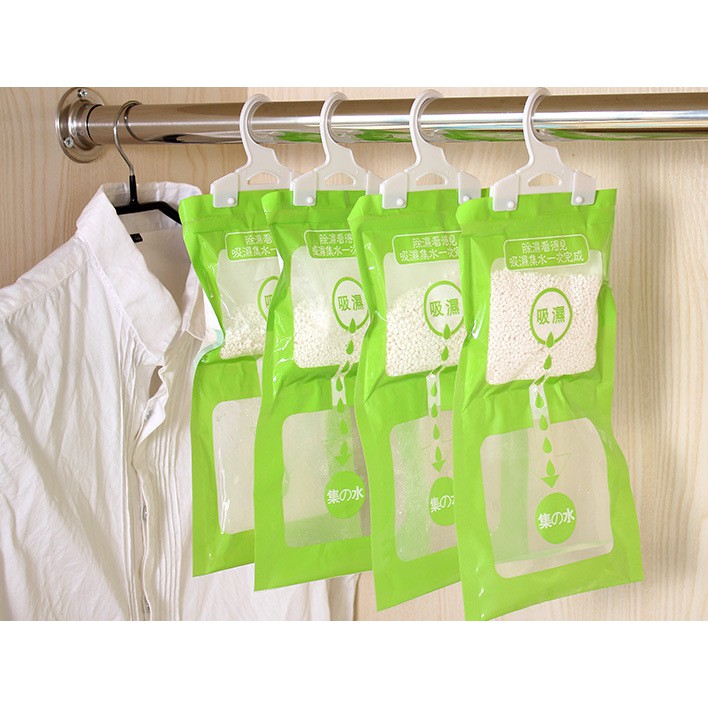
- Place packets at mid-height or on upper shelves: Humid air is denser than dry air and tends to pool at the bottom of the wardrobe. However, placing desiccant at mid-height or on an upper shelf absorbs moisture from the top zone and creates a downward gradient, drawing humidity up from below. Use hanging packets (silica gel 500g with hanging hook) where shelving is limited.
- Prioritize your most valuable items: Place one 50–100g packet directly inside the dust bag of leather goods, the shoe box for leather footwear, or the storage box for wool items. These materials absorb atmospheric moisture rapidly and deteriorate first.
- Maintain a minimum 5 cm clearance from garments: Silica gel generates no heat and poses no fire risk. However, a fully saturated packet left unchanged for several weeks can leave a faint mark if in prolonged direct contact with delicate fabric. Use a small perforated box or hook to maintain clearance.
- Check the indicator monthly: Use orange-indicator silica gel to know when replacement is needed. When the indicator has fully shifted to orange (for orange/white type), the packet has reached >60–70% of its capacity. Replace or regenerate immediately — see Silica Gel Regeneration Guide.
- Add packets to drawers storing underwear and knitwear: Drawers are more enclosed than the hanging section, have poor air circulation, and accumulate humidity faster. One 50g packet per 30×50 cm drawer is sufficient in normal seasons; increase to 100g per drawer during peak Nồm months.
How to Calculate the Quantity Needed by Wardrobe Volume (m³)
The reference formula used in the export packaging industry (adapted for enclosed residential wardrobes):
Silica gel quantity (g) = V (m³) × ΔRH × k
Where: V = wardrobe volume, ΔRH = target RH reduction (%), k = adjustment coefficient.
For residential wardrobes, k = 80–120 g/(m³·10%RH). Example: a 2 m³ wardrobe, target reduction from 90% to 60% RH (ΔRH = 30%): minimum 2 × 3 × 80 = 480g, rounded up to 500g for safety.
Quick-reference table:
| Wardrobe size | Estimated volume | Normal season (RH 60–70%) | Peak Nồm season (RH >90%) |
|---|---|---|---|
| Small single-door (90×50×180 cm) | ~0.8 m³ | 2 × 50g packets = 100g | 2 × 100g packets = 200g |
| Standard double-door (160×60×200 cm) | ~1.9 m³ | 3 × 100g packets = 300g | 5 × 100g packets = 500g |
| Large built-in wardrobe (250×65×240 cm) | ~3.9 m³ | 4 × 100g packets = 400g | 1 × 500g + 2 × 100g packets |
Coefficient adjustments: Multiply by 1.5× if the wardrobe has old or worn rubber seals (poor airtightness), or if the room has no air conditioning. Multiply by 0.8× if the wardrobe is opened daily (regular air circulation distributes humidity more evenly but also continuously reloads moisture).
Silica Gel Regeneration — The Correct Home Procedure
Silica gel is one of the few desiccants that can be fully regenerated, offering significant long-term cost savings. The home regeneration procedure:
- Confirm the silica gel type is safe to heat: Only regenerate orange-indicator (iron oxide) or plain white silica gel. Do NOT heat blue-indicator (CoCl₂) silica gel — it releases cobalt vapor at elevated temperatures. Read Is Silica Gel Safe to Eat? for a full breakdown of chemical composition.
- Temperature and duration: 110–130°C for 2–3 hours in a conventional oven. A microwave at 30% power for 10–15 minutes is also effective (faster but less uniform).
- Signs of completion: Indicator returns to its original color (orange → white or bright orange). If using a scale, post-drying weight should match the original dry weight ± 5%.
- Cool down and store: Allow to cool in a sealed container for at least 30 minutes before returning to the wardrobe. If storing temporarily, place in a zip-lock bag — cooled silica gel begins absorbing moisture immediately upon exposure to air.
- Number of regeneration cycles: Typically 5–7 cycles. After that, absorption capacity decreases as the microporous structure gradually contracts. Signs that replacement is needed: indicator no longer changes color clearly, or the packet remains light after one month in a humid wardrobe.
For the full regeneration procedure covering multiple methods: Silica Gel Regeneration — Standard Process and Safety Notes.
CEMACOSG Wardrobe Desiccant Products
CEMACOSG manufactures and distributes four products best suited for residential wardrobes and commercial garment storage. All products carry ISO 9001 and HACCP certification, manufactured at our Ho Chi Minh City facility:
- Silica Gel 50g Tyvek — Blue: Compact size for drawers and leather goods dust bags. Tyvek substrate sheds no fibers onto garments.
- Silica Gel 100g Non-Woven — Blue: Standard choice for 1–2 m³ wardrobes. Approximately 15% lower cost than Tyvek, ideal for high-volume use.
- Silica Gel 500g Non-Woven — Hanging Hook: Hangs directly on the clothing rail. Ideal for built-in wardrobes >3 m³ or seasonal storage wardrobes.
- Clay 100g Non-Woven — Blue: Cost-effective option for standard clothing wardrobes, performs well at RH 50–85%. Well-suited for companies procuring in bulk for employee wardrobe kits.
CEMACOSG supplies both individual consumers and B2B clients including garment manufacturers, fashion retail chains, and export-oriented enterprises. For export garment applications, see Desiccant Bags for Export Garment Industry and the industry page Apparel Industry Applications.
Health guidelines references: WHO Guidelines for Indoor Air Quality: Dampness and Mould · US EPA — Mold Course Chapter 2: Causes and Effects.
To receive a volume-based quote and sizing consultation for your wardrobe, contact us via form or call 0983 929 232 (24/7):
Need a quote based on this article?
The CEMACOSG technical team provides free consultation on desiccant quantity tailored to your cargo, route, and export requirements.