Food-Grade Desiccant: FDA Standards and Common Specifications
Food-grade desiccants approved to FDA 21 CFR 184.1711 control water activity, prevent mould, and extend shelf life. Selection guide for 1g/2g/5g packs — confectionery, dried nuts, pharma exports to US, EU, Japan.
TL;DR — Summary
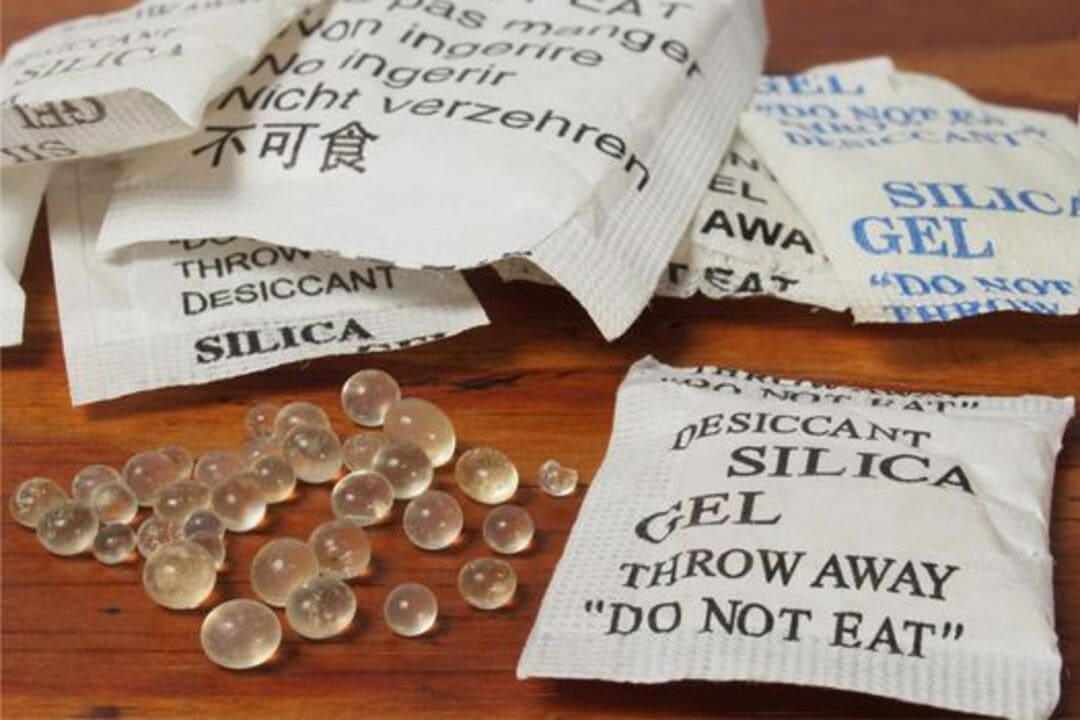
Food-grade desiccants are moisture-absorbing materials approved for direct or indirect contact with food under FDA 21 CFR 184.1711 (silica gel) and FDA 21 CFR 182.2727 (bentonite/clay). The two most common types are white silica gel Type A and food-grade montmorillonite clay. Cobalt chloride (CoCl₂) blue-indicating silica gel must never be used in food packaging — CoCl₂ is classified by IARC as Group 2B (possibly carcinogenic). Common pack sizes 1g, 2g, and 5g suit confectionery, dried nuts, and pharmaceuticals; larger formats are used for agricultural export containers.
What is a food-grade desiccant?
A food-grade desiccant is a moisture-absorbing material manufactured, packaged, and certified to regulatory standards permitting its use in food, pharmaceutical, or nutraceutical packaging. The critical distinction from industrial desiccants is that every material component in contact with food — the desiccant substance, the packaging substrate, and printed inks — must appear on a positive list of permitted materials maintained by regulators such as FDA (USA), EFSA (EU), or equivalent authorities.
The primary role of a desiccant in food preservation is to control water activity (aw). Applied food microbiology research establishes the following thresholds: moulds proliferate at aw ≥ 0.70; pathogenic bacteria (Salmonella, E. coli) grow at aw ≥ 0.85; lipid oxidation (rancidity) accelerates significantly above aw 0.30. By keeping aw below these critical thresholds, desiccants extend shelf life, preserve the crispness of baked goods, and prevent discolouration.
According to FAO statistics, approximately 14% of global food production is lost post-harvest and in transit — largely due to moisture. For Vietnamese agricultural exports (cashews, coffee, pepper, rice) destined for the USA, EU, and Japan, food-grade desiccants are a mandatory requirement under HACCP and ISO 22000 certifications required by importing partners.
3 types of food-grade desiccants
Three categories of moisture-control products are used in food packaging, but they operate via different mechanisms and cannot substitute for one another:
1. White silica gel Type A — food-grade
Silica gel (SiO₂·nH₂O) is the most widely used option. FDA lists silica gel as GRAS (Generally Recognized As Safe) under 21 CFR 184.1711, permitting its use as an anticaking agent in food at a maximum of 2% by food weight. The WHO Joint Expert Committee on Food Additives (JECFA) assigns an ADI of "not specified" — no limit on daily intake — provided the material meets specified purity requirements.
Key properties: absorbs 35–40% of its own weight, chemically inert, odourless, tasteless, and regenerable by drying at 110–130°C. Always specify white, CoCl₂-free silica gel. Browse CEMACO silica gel products.
2. Montmorillonite clay — food-grade
Bentonite/montmorillonite is a natural clay mineral. FDA permits it under 21 CFR 182.2727 (bentonite — GRAS) and the EU food additive list (EC 1333/2008, E558). Food-grade clay delivers highest moisture uptake at 20–40°C (typical tropical warehouse conditions), making it suitable for agricultural export containers. Drawback: not regenerable; saturates faster at high relative humidity.
3. Oxygen scavengers — not desiccants
Important distinction: oxygen scavengers are not desiccants. Oxygen scavengers absorb O₂ to prevent lipid oxidation and inhibit aerobic bacteria; desiccants absorb water vapour to control aw. In packaging for roasted coffee or fried snacks, both are often used together — each targeting a different deterioration mechanism.
| Type | Mechanism | FDA/EU Status | Regenerable | Typical Application |
|---|---|---|---|---|
| White silica gel | Water vapour adsorption | 21 CFR 184.1711 GRAS | Yes (dry 110°C) | Confectionery, pharma, electronics |
| Montmorillonite clay | Water vapour adsorption | 21 CFR 182.2727 GRAS | No | Agricultural containers, timber |
| Oxygen scavenger | Chemical reaction with O₂ | Depends on composition | No | Coffee, snacks, processed meat |
Key regulatory standards
When exporting packaged food to demanding markets, QA teams must verify desiccant compliance against the destination market's regulatory framework:
FDA 21 CFR 184.1711 and 182.2727 (US market)
Regulations issued by the US Food and Drug Administration. Silica gel under CFR 184.1711 is GRAS for direct food use. Suppliers must provide a Letter of Guarantee (LoG) confirming silica gel purity ≥ 99.5% SiO₂ and heavy metal content within limits (Pb ≤ 0.001%, As ≤ 0.0003%). See also: FDA 21 CFR guide for food desiccants.
EC 1935/2004 (EU market)
The EU framework regulation on materials and articles intended to contact food. Desiccants in direct contact with food must appear on the relevant Union list. Packaging substrates (Tyvek, non-woven fabric) must also comply with EC 1935/2004. See also: EC 1935/2004 and desiccant compliance for EU exports.
HACCP and ISO 22000
HACCP (Hazard Analysis and Critical Control Points) requires hazard analysis for all raw materials and auxiliary supplies including desiccants. Typical Critical Control Points (CCPs) for desiccants are: (1) verifying food-grade certification for each incoming batch; (2) ensuring packet integrity before insertion into food packaging; (3) confirming zero use of CoCl₂-containing products. ISO 22000 extends the same requirements across the entire supply chain. See: HACCP requirements for desiccants in food processing lines | Download CEMACO HACCP Certificate 2025.
Cobalt chloride (CoCl₂) blue-indicating silica gel must never be used in any food application. IARC classifies CoCl₂ as Group 2B (possibly carcinogenic to humans). EU REACH restrictions on CoCl₂ have been in effect since 2016. Acceptable alternatives: orange-indicating silica gel (methyl violet or iron oxide indicator) or plain white silica gel with no indicator.
For a comprehensive comparison of all desiccant types, read: Silica gel vs clay vs CaCl₂ — Complete comparison for exporters.
Common pack sizes by food type
Selecting the correct pack size depends on: packaging volume, target aw, storage temperature, and shelf life. The basic formula is: desiccant quantity (g) = packaging volume (litres) × environment factor (0.5–2 g/litre depending on conditions). The table below reflects actual industry practice:
| Food type / Packaging | Recommended size | Desiccant type | Notes |
|---|---|---|---|
| Confectionery carton 200g | Silica gel 1g × 1 | Food-grade silica gel | Target aw < 0.65 |
| Dried nuts (cashews, almonds) 500g bag | Silica gel 2g × 2 | Food-grade silica gel | Mould prevention + crispness |
| Pharmaceutical vial / 10-tablet blister | Silica gel 1g × 1 | Pharmaceutical-grade silica gel USP | CoA + LoG per USP <660> required |
| Roasted ground coffee 250g | Silica gel 5g + oxygen scavenger | Combined | Anti-rancidity + aw control |
| Tea bag box 100 sachets | Silica gel 5g × 1 | Food-grade silica gel | Preserve aroma, prevent carton moisture |
| 40ft agricultural container (green coffee, pepper) | Silica gel rope 500g × 4 + clay CaCl₂ | Silica gel + clay | See agricultural container preservation guide |
For precise calculations for your specific order, CEMACO's technical team provides free consultation and desiccant sizing. Request a consultation now.
How CEMACO supports the food industry
CEMACO provides a complete technical documentation package for every batch of food-grade desiccant:
- CoA (Certificate of Analysis) — per-batch physicochemical test results: SiO₂ content, heavy metals, initial moisture, adsorption capacity at RH 25% and 90%.
- MSDS / SDS — safety data sheets in GHS/CLP format, ready for EU/US customs clearance. Download MSDS silica gel 2025.
- FDA Letter of Guarantee — written commitment confirming compliance with 21 CFR 184.1711.
- HACCP Certificate — manufacturing facility is HACCP-certified and ISO 22000 audit-ready. View certifications.
For food exporters requiring complete documentation quickly, CEMACO processes requests within 24 business hours. For the complete documentation guide for export desiccants, see: MSDS Handbook — Export desiccant documentation kit.
CEMACO also offers custom printing (brand logo, "DO NOT EAT" warnings in multiple languages per EU/FDA requirements) and custom pack sizes from 1,000 units per order. View all food industry applications at: CEMACO food industry desiccant solutions.
4 food-grade SKUs from CEMACO
CEMACO supplies four food-grade desiccant SKUs best suited for the food and pharmaceutical sectors:
- Silica Gel 1g — Red Non-woven Fabric: smallest format, ideal for pharmaceutical packaging, individual confectionery units, functional food accessories.
- Silica Gel 5g — Red Non-woven Fabric: most popular for 250–500g food packaging, tea, coffee, and dried nuts.
- Silica Gel 50g — Tyvek with Logo: for large cartons and domestic containers.
- Clay Montmorillonite 30g — Kraft Paper: alternative to silica gel under hot tropical conditions, agricultural export containers.
Browse the full silica gel range: CEMACO Silica Gel Products. For a comprehensive desiccant selection guide: Silica Gel — Complete guide.
Regulatory references: FDA 21 CFR 184.1711 — Silicon Dioxide GRAS · FDA 21 CFR 182.2727 — Sodium Bentonite · FAO/WHO JECFA — Silicon Dioxide ADI Not Specified.
Need a quote for food-grade desiccants with FDA/HACCP compliance? CEMACO's technical team offers free consultation and delivers CoA + LoG within 24 hours.
Request a quote now | Hotline: 0983 929 232
Need a quote based on this article?
The CEMACOSG technical team provides free consultation on desiccant quantity tailored to your cargo, route, and export requirements.